


Page 94 - IJB-5-1
P. 94
Gao and Zhou
           parameters, including diameter of glass capillary nozzle,   other authors [23,24] .  This  review  only  introduces  three-
           hydrostatic back pressure head in the reservoir, and   dimensional  (3D) printing that we are interested,  and
           standoff height . When other processing parameters are   applications  of  two-dimensional  (2D)  printing  are
                       [19]
           maintained the same, onset jetting voltage for hole-type   reviewed for comparison reasons. Most EHD printing
           electrode is larger than that for plane-type electrode since   applications  have been focused on 2D printing, and
           the  less surface area  of electrode  in the  previous type.   only a few research  groups have explored  3D printing
           However, when the gap distance was larger than 200 µm,   techniques that are restricted by several issues discussed
           the  onset  jetting voltage  was insensitive  to  the  change   in previous sections. The following sections review the
           of hole  diameter .  The  assumption  that  onset  radius   representative results of both 2D and 3D printings.
                         [19]
           of curvature is not affected by the whole distribution of
           electric field for the same nozzle seems reasonable from   3.1. Applications of EHD 2D Printing
           simulation results . Thus, value of onset electric field at
                          [19]
           the meniscus did not change with either diameter of hole   3.1.1 Electronics Applications
           or gap distance .                                   EHD inkjet printing is an attractive fabrication method for
                       [19]
             Lee et al. used a ring-shaped gate electrode to suppress   microscale electronic devices since this method can obtain
           intact jet from generating satellite droplets or spraying .   features with fine resolution and it is compatible with a
                                                        [20]
           A maximal suppression was obtained as the inner diameter   series of functional inks. The rest of this section introduces
           of ring electrode is 5 times bigger than the outer diameter   several applications of EHD printing in fabrication  of
           of nozzle, and the gap distance between nozzle tip and   electronic components. As an example, Park et al. used
           gate electrode is 2½ times as big as the outer diameter   EHD method to print photocurable  polyurethane (PU)
           of nozzle . Tse developed a double layer electric field   precursor as a resist layer for patterning metal electrodes
                   [20]
           shaping print  head  to obtain  smaller  size  of droplets   by chemical etching . The printing results are shown in
                                                                                [9]
           compared  to  results  from  single  layer  field  shaping   Figure 4A and B.
           print head . To maintain constant operating conditions,   Metallo-organic  compound  solutions  and  inks
                   [21]
           Barton et al. investigated a two degree of freedom control   formulated from metal nanoparticle suspension are two
           algorithm .  They used an iterative  learning control   main kinds of ink for printing metallic patterns. The former
                   [21]
           algorithm and a feedback controller to obtain feedforward   ink is a true solution where the metal salt is fully dissolved
           control signal. The feedforward voltage signal is applied   in  the  solvent  and  this  property  decreases  sediments
           to compensate for repeatable changes, such as standoff   and clogging  issues arising  from nanoparticles  in the
           height,  and feedback  component  is employed  for   suspension . An uniform silver microtracks with a 35-
                                                                        [25]
           uncertainty in jetting operating conditions . Table 2 lists   µm line width was printed by Wang et al., and its resistivity
                                              [22]
           some optional solutions for problems that usually appear   was measured to be within a range of (2–4)×10 Ωm,
                                                                                                         −8
           in EHD printing process.                            which is 2.4 times of the theoretical value of bulk silver
                                                                      −8
           4. Applications of EHD Inkjet Printing              (1.6 × 10 Ωm) [25,26] . As shown in Figure 4C, the edge of
                                                               micro track is more porous compared to central part, since
           EHD  printing  is  developed  as  a  cost-effective  inkjet   repulsive interaction between the charged droplets leads
           printing  process with high resolution.  With  EHD   to an incompletely suppressed jet breakup. Sutanto et al.
           printing,  functional  materials  can  be  selectively  and   successfully fabricated a crossover intersecting structure
           precisely printed on desired substrates. Applications of   using  a  multimaterial  e-jet  printing  system  to  deposit
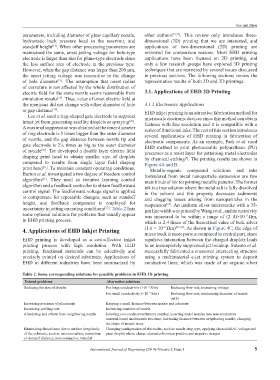
           EHD in different industries have been summarized  by   conductive lines, which was made of an organic silver

           Table 2. Some corresponding solutions for possible problems in EHD 3D printing
           Existed problems                   Alternative solutions
                                                                −4
           Reducing the size of droplet       For large conductivity (≥10  S/m)  Reducing flow rate, increasing voltage
                                              For small conductivity (<10  S/m)  Reducing flow rate, minimizing diameter of nozzle
                                                                −4
                                                                          outlet
           Increasing precision of placement  Keeping a small distance between nozzle and substrate
           Increasing yielding rate           Increasing numbers of nozzle
           Alleviating end effects from neighboring nozzle  Inserting non-conductive/dummy nozzles; inserting metal nozzles into non-conductive
                                              material-based multinozzle structure; increasing distance between neighboring nozzle; changing
                                              the shape of nozzle array
           Eliminating disturbance due to surface irregularity   Changing configuration of electrodes, such as nozzle-ring type; applying sinusoidal AC voltage and
           of the substrate, such as uneven surface, restriction   print droplet whose charge alternates between positive and negative charges
           of standoff distance, non-conductive material

                                       International Journal of Bioprinting (2019)–Volume 5, Issue 1         5

