


Page 15 - IJB-10-5
P. 15
International Journal of Bioprinting                                3D bioprinting for nanoparticle evaluation


                                                                              37
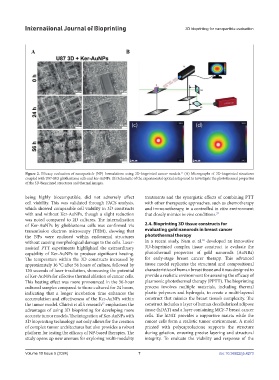
            Figure 2. Efficacy evaluation of nanoparticle (NP) formulations using 3D-bioprinted cancer models.  (A) Micrographs of 3D-bioprinted structures
            coupled with U87-MG glioblastoma cells and ker-AuNPs. (B) Schematic of the experimental optical setup used to investigate the photothermal properties
            of the 3D-bioprinted structures and thermal images.

            being highly biocompatible, did not adversely affect   treatments and the synergistic effects of combining PTT
            cell viability. This was validated through FACS analysis,   with other therapeutic approaches, such as chemotherapy
            which showed comparable cell viability in 3D constructs   and immunotherapy, in a controlled in vitro environment
            with and without Ker-AuNPs, though a slight reduction   that closely mimics in vivo conditions. 37
            was  noted  compared  to  2D  cultures.  The  internalization
            of Ker-AuNPs by glioblastoma cells was confirmed via   2.4. Bioprinting 3D tissue constructs for
            transmission electron microscopy (TEM), showing that   evaluating gold nanorods in breast cancer
            the NPs were enclosed within endosomal structures   photothermal therapy
                                                                                       38
            without causing morphological damage to the cells. Laser-  In  a  recent  study,  Nam  et  al.   developed  an  innovative
            assisted PTT experiments highlighted the extraordinary   3D-bioprinted complex tissue construct to evaluate the
            capability of Ker-AuNPs to produce significant heating.   photothermal properties of gold nanorods (AuNRs)
            The  temperature  within  the  3D  constructs  increased  by   for early-stage breast cancer therapy. This advanced
            approximately 16  °C after 56 hours of culture, followed by   tissue model replicates the structural and compositional
            120 seconds of laser irradiation, showcasing the potential   characteristics of human breast tissue and it was designed to
            of Ker-AuNPs for effective thermal ablation of cancer cells.   provide a realistic environment for assessing the efficacy of
            This heating effect was more pronounced in the 56-hour   plasmonic photothermal therapy (PPTT). The bioprinting
            cultured samples compared to those cultured for 24 hours,   process involves multiple materials, including thermal
            indicating that a longer incubation time enhances the   plastic polymers and hydrogels, to create a multi-layered
            accumulation and effectiveness of the Ker-AuNPs within   construct that mimics the breast tissue’s complexity. The
            the tumor model. Chirivì et al.’s research  emphasizes the   construct includes a layer of human decellularized adipose
                                            37
            advantages of using 3D bioprinting for developing more   tissue (hDAT) and a layer containing MCF-7 breast cancer
            accurate tumor models. The integration of Ker-AuNPs with   cells. The hDAT provides a supportive matrix while the
            3D bioprinting technology not only allows for the creation   cancer cells form a realistic tumor environment. A mold
            of complex tumor architectures but also provides a robust   printed with polycaprolactone supports the structure
            platform for testing the efficacy of NP-based therapies. The   during gelation, ensuring precise layering and structural
            study opens up new avenues for exploring multi-modality   integrity. To evaluate the viability and response of the


            Volume 10 Issue 5 (2024)                        7                                 doi: 10.36922/ijb.4273

