


Page 419 - IJB-10-5
P. 419
International Journal of Bioprinting                                     Stability of 3D-printed PEO tablets


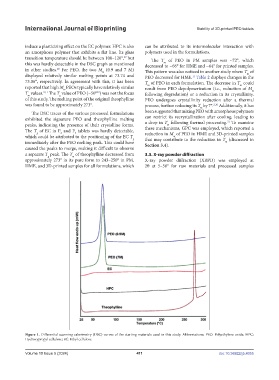
            induce a plasticizing effect on the EC polymer. HPC is also   can be attributed to its intermolecular interaction with
            an amorphous polymer that exhibits a flat line. Its glass   polymers used in the formulations.
                                                      27
            transition temperature should be between 100–120°,  but   The  T  of PEO in PM samples was ~72°, which
                                                                       m
            this was hardly detectable in the DSC graph as mentioned   decreased to ~66° for HME and ~64° for printed samples.
            in other studies.  For PEO, the two  M  (0.9 and 7 M)   This pattern was also noticed in another study where T  of
                         28
                                             w
                                                                                                          m
            displayed relatively similar melting points at 73.74 and   PEO decreased for HME.  Table 2 displays changes in the
                                                                                   13
            73.06°, respectively. In agreement with this, it has been   T  of PEO in each formulation. The decrease in T  could
                                                                                                       m
                                                                m
            reported that high M  PEOs typically have relatively similar   result from PEO depolymerization (i.e., reduction of M
                            w
                                                                                                             w
            T  values.  The T  value of PEO (−50° ) was not the focus   following degradation) or a reduction in its crystallinity.
                    9,11
                                          29
             m
                          g
            of this study. The melting point of the original theophylline   PEO undergoes crystallinity reduction after a thermal
            was found to be approximately 273°.                process, further reducing its T  by 7°.  Additionally, it has
                                                                                            2,30
                                                                                      m
               The DSC traces of the various processed formulations   been suggested that mixing PEO with amorphous polymers
            exhibited the signature PEO and theophylline melting   can restrict its recrystallization after cooling, leading to
                                                                                                  31
            peaks, indicating the presence of their crystalline forms.   a drop in T  following thermal processing.  To examine
                                                                        m
            The T  of EC in F  and F  tablets was hardly detectable,   these mechanisms, GPC was employed, which reported a
                                 4
                 g
                           3
            which could be attributed to the positioning of the EC T   g  reduction in M  of PEO in HME and 3D-printed samples
                                                                           w
                                                               that may contribute to the reduction in T  (discussed in
            immediately after the PEO melting peak. This could have   Section 3.4).              m
            caused the peaks to merge, making it difficult to observe
            a separate T  peak. The T  of theophylline decreased from   3.3. X-ray powder diffraction
                     g
                                m
            approximately 273° in its pure form to 243–250° in PM,   X-ray powder diffraction (XRPD) was employed at
            HME, and 3D-printed samples for all formulations, which   2θ at 5–50° for raw materials and processed samples


            Figure 1. Differential scanning calorimetry (DSC) curves of the starting materials used in this study. Abbreviations: PEO: Polyethylene oxide; HPC:
            Hydroxypropyl cellulose; EC: Ethyl cellulose.


            Volume 10 Issue 5 (2024)                       411                                doi: 10.36922/ijb.4055

