


Page 488 - IJB-10-5
P. 488
International Journal of Bioprinting                             Biocompatible 3D-printed radiotherapy spacer


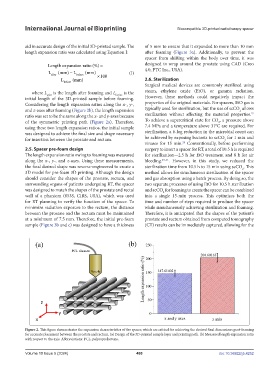
            aid in accurate design of the initial 3D-printed sample. The   of 5 mm to ensure that it expanded to more than 10 mm
            length expansion ratio was calculated using Equation I:  after foaming (Figure 3a). Additionally, to prevent the
                                                               spacer from shifting within the body over time, it was
                      Length expansionratio (%) =              designed to wrap around the prostate using CAD (Creo

                      L after  ( mm) − L before  ( mm) ×1100  (I)  4.0, PTC Inc., USA).
                           L before  ( mm)                     2.6. Sterilization
                                                               Surgical medical devices are commonly sterilized using
               where L after  is the length after foaming and L before  is the   steam, ethylene oxide (EtO), or gamma radiation.
            initial length of the 3D-printed sample before foaming.   However, these methods could negatively impact the
            Considering the length expansion ratios along the x-, y-,   properties of the original materials. For spacers, EtO gas is
            and z-axes after foaming (Figure 2b), the length expansion   typically used for sterilization, but the use of scCO  allows
                                                                                                       2
                                                                                                            27
            ratio was set to be the same along the x- and y-axes because   sterilization without affecting the material properties.
            of the symmetric printing path (Figure 2a). Therefore,   To achieve a supercritical state for CO , a pressure above
                                                                                              2
            using these two length expansion ratios, the initial sample   7.4 MPa and a temperature above 31°C are required. For
            was designed to achieve the final size and shape necessary   sterilization, a 6-log reduction in the microbial count can
            for insertion between the prostate and rectum.     be achieved by exposing bacteria to scCO  for 1 min and
                                                                                                 2
                                                               viruses for 15 min.  Conventionally, before performing
                                                                               28
            2.5. Spacer pre-foam design                        surgery to insert a spacer for RT, a total of 10.5 h is required
            The length expansion ratio owing to foaming was measured   for sterilization—2.5 h for EtO treatment and 8 h for air
            along the  x-,  y-, and  z-axes. Using these measurements,   bleeding. 29–31 . However, in this study, we reduced the
            the final desired shape was reverse-engineered to create a   sterilization time from 10.5 h to 15 min using scCO . This
                                                                                                        2
            3D model for pre-foam 3D printing. Although the design   method allows for simultaneous sterilization of the spacer
            should  consider  the  shapes  of  the  prostate,  rectum,  and   and gas absorption using a batch process. By doing so, the
            surrounding organs of patients undergoing RT, the spacer   two separate processes of using EtO for 10.5 h sterilization
            was designed to match the shapes of the prostate and rectal   and scCO  for foaming to create the spacer can be combined
                                                                       2
            wall of a phantom (053S, CIRS, USA), which was used   into a single 15-min process. This optimizes both the
            for RT planning to verify the function of the spacer. To   time and number of steps required to produce the spacer
            minimize radiation exposure to the rectum, the distance   while simultaneously achieving sterilization and foaming.
            between the prostate and the rectum must be maintained   Therefore, it is anticipated that the shapes of the patient’s
            at a minimum of 7.5 mm. Therefore, the initial pre-foam   prostate and rectum obtained from computed tomography
            sample (Figure 3b and c) was designed to have a thickness   (CT) results can be immediately captured, allowing for the


            Figure 2. This figure demonstrates the expansion characteristics of the spacer, which are critical for achieving the desired final dimensions post-foaming
            for accurate placement between the prostate and rectum. (a) Design of the 3D-printed sample layer and printing path. (b) Measured length expansion ratio
            with respect to the axis. Abbreviations: PCL, polycaprolactone.


            Volume 10 Issue 5 (2024)                       480                                doi: 10.36922/ijb.4252

