


Page 80 - IJB-10-5
P. 80
International Journal of Bioprinting                            dECM bioink for 3D musculoskeletal tissue reg.


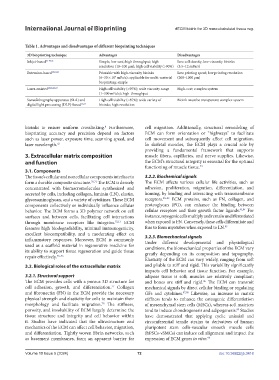
            Table 1. Advantages and disadvantages of different bioprinting techniques
             3D bioprinting technique      Advantages                        Disadvantages
             Inkjet-based 46-49,63         Simple; low-cost; high throughput; high   Low cell density; low-viscosity bioinks
                                           resolution (10–100 μm); high cell viability (>90%)  (3.5–12 mPa/s)
             Extrusion-based 38,64,65      Printable with high-viscosity bioinks    Low printing speed; low printing resolution
                                           (6–30 × 10  mPa/s); applicable for multi-material   (200–1000 μm)
                                                  7
                                           bioprinting; simple
             Laser-assisted 20,58,66,67    High cell viability (>95%); wide viscosity range   High-cost; complex system
                                           (1–300 mPa/s); high-throughput
             Stereolithography apparatus (SLA) and   High cell viability (>85%); wide variety of   Bioink must be transparent; complex system
             digital light processing (DLP)-based 68,69  bioinks; high resolution


            bioinks to ensure uniform crosslinking.  Furthermore,   cell migration. Additionally, structural remodeling of
                                              8
            bioprinting accuracy and precision depend on factors   ECM  can  form  orientation  or  “highways”  to  facilitate
            such as laser power, exposure time, scanning speed, and   cell movement and subsequently affect cell migration.
            laser wavelength. 62                               In skeletal muscles, the ECM plays a crucial role by
                                                               providing  a  fundamental  framework  that  supports
            3. Extracellular matrix composition                muscle fibers, capillaries, and nerve supplies. Likewise,
            and function                                       the ECM’s structural integrity is essential for the optimal
                                                               functioning of muscle tissue. 79
            3.1. Components
            The tissue’s cellular and noncellular components interlace to   3.2.2. Biochemical signals
            form a durable composite structure. 70,71  The ECM is densely   The ECM affects various cellular life activities, such as
            concentrated with biomacromolecules synthesized and   adhesion, proliferation,  migration, differentiation, and
            secreted by cells, including collagen, laminin (LN), elastin,   homing, by binding and interacting with transmembrane
            glycosaminoglycan, and a variety of cytokines. These ECM   receptors. 80–82  ECM proteins, such as FN, collagen, and
            components collectively or individually influence cellular   proteoglycan (PG), can enhance the binding between
            behavior. The ECM forms a 3D polymer network on cell   cellular  receptors  and  their  growth  factor ligands. 83,84   For
            surfaces and  between cells, facilitating cell interactions   instance, myogenic cells multiply and remain undifferentiated
            through membrane receptors like integrins. 72,13  ECM   when exposed to FN. Conversely, these cells differentiate and
            features high biodegradability, minimal immunogenicity,   fuse to form myotubes when exposed to LN. 85
            excellent biocompatibility, and a moderating effect on
            inflammatory responses. Moreover, ECM is commonly   3.2.3. Biomechanical signals
                                                               Under different developmental and physiological
            used  as  a scaffold  material  in regenerative  medicine  for   conditions, the biomechanical properties of the ECM vary
            its ability to support tissue regeneration and guide tissue   greatly depending on its composition and topography.
            repair effectively. 73–76
                                                               Elasticity of the ECM can vary widely, ranging from soft
            3.2. Biological roles of the extracellular matrix  and pliable to stiff and rigid. This variability significantly
                                                               impacts cell behavior and tissue function. For example,
            3.2.1. Structural support                          adipose tissue is soft; muscles are relatively compliant;
            The ECM provides cells with a porous 3D structure for   and bones are stiff and rigid.  The ECM can transmit
                                                                                        86
            cell adhesion, growth, and differentiation.  Collagen   mechanical signals by direct cellular binding or regulating
                                                 77
            and fibronectin (FN) in the ECM provide the necessary   GFs and cytokines. 87,88  Likewise, an increase in matrix
            physical strength and elasticity for cells to maintain their   stiffness tends to enhance the osteogenic differentiation
            morphology and facilitate migration.  The stiffness,   of mesenchymal stem cells (MSCs), whereas soft matrices
                                            78
            porosity, and insolubility of ECM largely determine the   tend to induce chondrogenesis and adipogenesis.  Studies
                                                                                                      89
            tissue structure and integrity and cell behavior within   have  demonstrated  that  applying  cyclic  uniaxial and
            it. Studies have indicated that the ultrastructure and   circumferential tensile strains to derivatives of human
            mechanics of the ECM can affect cell behavior, migration,   pluripotent stem cells-vascular smooth muscle cells
            and differentiation. Tightly woven fibrin networks, such   (hPSCs-vSMCs) can induce cell alignment and impact the
            as basement membranes, form an apparent barrier for   expression of ECM genes in vitro. 90


            Volume 10 Issue 5 (2024)                        72                                doi: 10.36922/ijb.3418

