


Page 39 - IJB-6-1
P. 39
Zhang, et al.
extrusion pressure, and needle parameters. The diameter will subsequently decrease. If the printing
ink velocity alongside the needle (V z(nozzle) ). and the speed lower than the range, ink accumulation will
corresponding extrusion rate (Q z(extrusion) ). follow occur and the filament diameter will increase.
the power-law equation; these parameters can be The substrate can affect filament formation.
calculated using Equation 3.1 and 3.2 : As shown in Figure 3B, two filaments were
[49]
1 n1+ formed with different contact angle values on
R n ∆ P n r n
V ( z nozzle ∫ γ dr = ( ) [1− ] 3.1 the substrate; the structure of a filament with a
=
)
r n + 1 2KL R large contact angle value can be maintained.
1 On the other hand, a small contact angle value
R ∆ PR n n Rπ 3 can improve the stability of the scaffold. In
=
π
Q z (extrusion ∫ 2 RV dr = ( ) 3.2 most cases, the substrate (e.g., glass) can have
)
Z
0 2KL 3n + 1
large contact angles with the filament. By
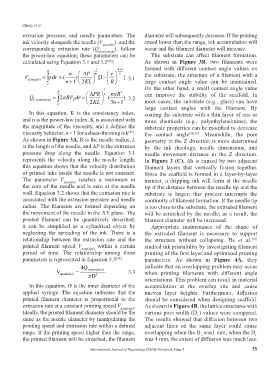
In this equation, K is the consistency index, coating the substrate with a thin layer of one or
and n is the power-law index. K is associated with more chemicals (e.g., polyethyleneimine), the
the magnitude of the viscosity, and n defines the substrate properties can be modified to decrease
viscosity behavior; n < 1 for a shear-thinning ink . the contact angle [38,50] . Meanwhile, the pore
[49]
As shown in Figure 3A, R is the needle radius, L geometry in the Z direction is more determined
is the length of the needle, and ∆P is the extrusion by the ink rheology, needle dimensions, and
pressure drop along the needle. Equation 3.1 needle movement distance in the Z direction.
represents the velocity along the needle length; In Figure 3 (C), ∆h is caused by two adjacent
this equation shows that the velocity distribution filament layers that vertically fusion together.
of printed inks inside the needle is not constant. Since the scaffold is formed in a layer-by-layer
The parameter V z(nozzle) reaches a maximum in manner, a dripping ink will form at the needle
the core of the needle and is zero at the needle tip if the distance between the needle tip and the
wall. Equation 3.2 shows that the extrusion rate is substrate is larger; this process interrupts the
associated with the extrusion pressure and needle continuity of filament formation. If the needle tip
radius. The filaments are formed depending on is too close to the substrate, the extruded filament
the movement of the needle in the XY plane. The will be scratched by the needle; as a result, the
printed filament can be quantitively described; filament diameter will be increased.
it can be simplified as a cylindrical object by Appropriate maintenance of the shape of
neglecting the spreading of the ink. There is a the extruded filament is necessary to support
relationship between the extrusion rate and the the structure without collapsing. He et al. [19]
printed filament speed V nozzle(xy) within a certain studied ink printability by investigating filament
period of time. The relationship among these printing of the first layer and optimized printing
parameters is represented in Equation 3.3 . parameters. As shown in Figure 4A, they
[38]
4Q indicate that an overlapping problem may occur
V = z(extrusion) 3.3 when printing filaments with different angle
nozzle(xy)
D 2
π
orientations. This problem can result in material
In this equation, D is the inner diameter of the accumulation at the overlap site and cause
applied syringe. The equation indicates that the uneven layer heights. Furthermore, diffusion
printed filament diameter is proportional to the should be considered when designing scaffold.
extrusion rate at a constant printing speed V . As shown in Figure 4B, the lattice structures with
nozzle(xy)
Ideally, the printed filament diameter should be the various pore width (D ) values were compared.
L
same as the nozzle diameter by manipulating the The results showed that diffusion between two
printing speed and extrusion rate within a defined adjacent lines on the same layer could cause
range. If the printing speed higher than the range, overlapping when the D was1 mm; when the D
L
L
the printed filament will be stretched; the filament was 4 mm, the extent of diffusion was much less.
International Journal of Bioprinting (2020)–Volume 6, Issue 1 35

