


Page 40 - IJB-6-1
P. 40
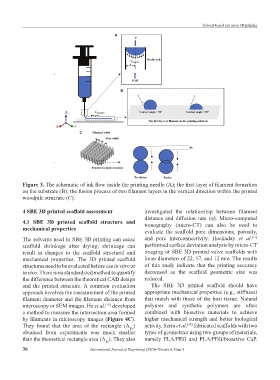
Solvent-based extrusion 3D printing

                                                  A


                                                    B


                                   C


           Figure 3. The schematic of ink flow inside the printing needle (A); the first layer of filament formation
           on the substrate (B); the fusion process of two filament layers in the vertical direction within the printed
           woodpile structure (C).

           4 SBE 3D printed scaffold assessment                investigated  the  relationship  between  filament
                                                               distance and diffusion rate (φ). Micro-computed
           4.1  SBE  3D  printed  scaffold  structure  and     tomography (micro-CT)  can also be used to
           mechanical properties                               evaluate  the  scaffold  pore  dimensions,  porosity,
                                                                                                            [11]
           The solvents used in SBE 3D printing can cause      and  pore interconnectivity. Hockaday  et  al.
           scaffold  shrinkage  after  drying;  shrinkage  can   performed surface deviation analysis by micro-CT
           result  in  changes  to  the  scaffold  structural  and   imaging of SBE 3D printed valve scaffolds with
           mechanical  properties.  The  3D  printed  scaffold   inner diameters of 22, 17, and 12 mm. The results
           structures need to be evaluated before use in vitro or   of this study indicate  that the  printing  accuracy
           in vivo. There is no standardized method to quantify   decreased  as  the  scaffold  geometric  size  was
           the difference between the theoretical CAD design   reduced.
           and the printed structure. A  common evaluation       The  SBE  3D  printed  scaffold  should  have
           approach involves the measurement of the printed    appropriate mechanical properties (e.g., stiffness)
           filament diameter and the filament distance from    that match with those of the host tissue. Natural
           microscopy or SEM images. He et al.  developed      polymer  and synthetic  polymers  are  often
                                              [19]
           a method to measure the intersection area formed    combined  with bioactive  materials  to achieve
           by filaments in microscopy images (Figure 4C).      higher mechanical strength and better biological
           They found that the area  of the rectangle  (A )    activity. Serra et al.  fabricated scaffolds with two
                                                                                 [35]
                                                        Re
           obtained  from  experiments  was much  smaller      types of geometries using two groups of materials,
           than the theoretical rectangle area (A ). They also   namely  PLA/PEG and PLA/PEG/bioactive  CaP.
                                              Rt
           36                          International Journal of Bioprinting (2020)–Volume 6, Issue 1

