


Page 100 - IJB-7-1
P. 100
3D Printing of Ceramic Dental Prostheses
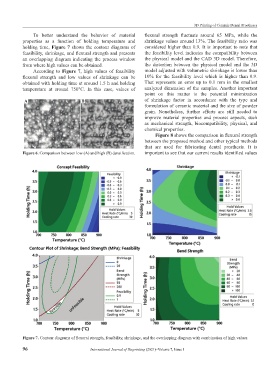
               To better  understand  the  behavior  of material   flexural  strength  fluctuate  around  65  MPa,  while  the
           properties as a function of holding temperature  and   shrinkage values around 13%. The feasibility ratio was
           holding time, Figure 7 shows the contour diagrams of   considered higher than 0.9. It is important to note that
           feasibility, shrinkage, and flexural strength and presents   the feasibility level indicates the compatibility between
           an overlapping diagram indicating the process window   the physical model and the CAD 3D model. Therefore,
           from where high values can be obtained.             the  distortion  between  the  physical  model  and  the  3D
               According to  Figure  7, high values of feasibility   model adjusted with volumetric shrinkage is lower than
           flexural  strength  and  low  values  of  shrinkage  can  be   10%  for  the  feasibility  level  which  is  higher  than  0.9.
           obtained with holding time at around 1.5 h and holding   That  represents  an  error  up  to  0.1  mm  in  the  smallest
           temperature  at  around  750°C.  In  this  case,  values  of   analyzed  dimension  of the  samples. Another  important
                                                               point  on this matter  is the potential  minimization
           A                        B                          of  shrinkage  factor  in  accordance  with  the  type  and
                                                               formulation of ceramic material and the size of powder
                                                               grain.  Nonetheless,  further  efforts  are  still  needed  to
                                                               improve  material  properties  and process aspects,  such
                                                               as mechanical  strength, biocompatibility, physical, and
                                                               chemical properties.
                                                                   Figure 8 shows the comparison in flexural strength
                                                               between the proposed method and other typical methods
                                                               that  are used for fabricating dental  prosthesis. It is
           Figure 6. Comparison between low (A) and high (B) densification.  important to see that our current results identified values


           Figure 7. Contour diagrams of flexural strength, feasibility, shrinkage, and the overlapping diagram with combination of high values.

           96                          International Journal of Bioprinting (2021)–Volume 7, Issue 1

