


Page 101 - IJB-7-1
P. 101
Cunico


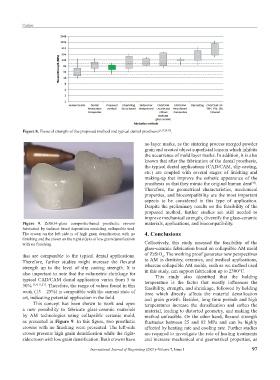
           Figure 8. Flexural strength of the proposed method and typical dental prosthesis [3,17,28-37] .

                                                               no layer marks, as the sintering process merged powder
                                                               grain and created object superficial tension which inhibits
                                                               the occurrence of mold layer marks. In addition, it is also
                                                               known that after the fabrication of the dental prosthesis,
                                                               the typical dental applications (CAD/CAM, slip casting,
                                                               etc.)  are  coupled  with  several  stages  of  finishing  and
                                                               making-up  that  improve  the  esthetic  appearance  of  the
                                                               prosthesis so that they mimic the original human dent .
                                                                                                            [38]
                                                               Therefore, the geometrical  characteristics,  mechanical
                                                               properties, and biocompatibility are the most important
                                                               aspects to be considered in this type of application.
                                                               Despite the preliminary results on the feasibility of the
                                                               proposed method, further studies are still needed to
                                                               improve mechanical strength, diversify the glass-ceramic
           Figure 9.  ZrSiO4-glass  composite-based  prosthetic  crowns   materials, applications, and biocompatibility.
           fabricated by indirect fused deposition modeling collapsible tool.
           The crown on the left side is of high grain densification with no   4. Conclusions
           finishing and the crown on the right side is of low grain densification
           with no finishing.                                  Collectively, this study assessed the feasibility  of the
                                                               glass-ceramic fabrication based on collapsible AM mold
           that  are comparable  to  the  typical  dental  applications.   of ZrSiO . The working proof generates new perspectives
                                                                      4
           Therefore,  further  studies  might  increase  the  flexural   to AM in dentistry, ceramics, and medical applications,
           strength  up to  the  level  of slip  casting  strength.  It  is   whereas collapsible AM molds, such as we method used
           also important to note that the volumetric shrinkage for   in this study, can support fabrication up to 2300°C.
                                                                   This  study  also  identified  that  the  holding
           typical  CAD/CAM  dental  application  varies  from  5  to   temperature  is  the  factor  that  mostly  influences  the
           30%  [3,4,17,27] . Therefore, the range of values found in this   feasibility, strength, and shrinkage, followed by holding
           work (13 – 25%) is compatible with the current state of   time  which  directly  affects  the  material  densification
           art, indicating potential application in the field.   and grain growth. Besides, long time periods and high
               This  concept  has  been  shown  to  work  and  open   temperatures  increase  the  densification  and  soften  the
           a  new  possibility  to  fabricate  glass-ceramic  materials   material, leading to distorted geometry, and making the
           by  AM technologies using collapsible  ceramic  mold,   method unfeasible. On the other hand, flexural strength
           as presented in Figure 9. In this figure, two prosthetic   fluctuates  between  25  and  82  MPa  and  can  be  highly
           crowns  with  no  finishing  were  presented. The  left-side   affected by heating rate and cooling rate. Further studies
           crown presents high grain densification while the right-  are required to investigate the role of heating treatments
           side crown with low grain densification. Both crowns have   and increase mechanical and geometrical properties, as

                                       International Journal of Bioprinting (2021)–Volume 7, Issue 1        97

