


Page 39 - IJB-7-2
P. 39
Zhang, et al.

                        A                                    B


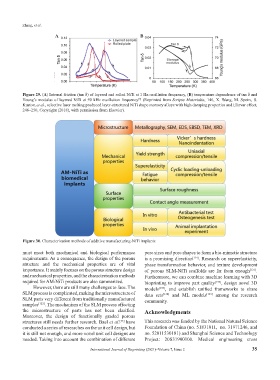
           Figure 29. (A) Internal friction (tan δ) of layered and rolled NiTi at 1 Hz oscillation frequency, (B) temperature dependence of tan δ and
                                                            [9]
           Young’s modulus of layered NiTi at 90 kHz oscillation frequency  (Reprinted from Scripta Materialia, 146, X. Wang, M. Speirs, S.
           Kustov, et al., selective laser melting produced layer-structured NiTi shape memory alloys with high damping properties and Elinvar effect,
           246–250, Copyright (2018), with permission from Elsevier).


           Figure 30. Characterization methods of additive manufacturing-NiTi implants.

           must  meet  both mechanical  and biological  performance   pore sizes and pore shapes to form a bio-mimetic structure
           requirements. As a consequence, the design of the porous   is a promising direction [114] . Research on superelasticity,
           structure and the mechanical properties are of vital   phase transformation behavior, and texture development
           importance. It mainly focuses on the porous structure design   of porous SLM-NiTi scaffolds are far from enough [131] .
           and mechanical properties, and the characterization methods   Furthermore, we can combine machine learning with 3D
           required for AM-NiTi products are also summarized.   bioprinting to improve part quality [132] , design novel 3D
               However, there are still many challenges to face. The   models [133] ,  and  establish  unified  frameworks  to  share
           SLM process is complicated, making the microstructure of   data  sets [134]  and ML models [135]  among the research
           SLM parts very different from traditionally manufactured   community.
           samples [122] . The mechanism of the SLM process affecting
           the  microstructure  of  parts  has  not  been  clarified.   Acknowledgments
           Moreover, the design of functionally  graded porous
           structures still needs further research. Bael et al.  have   This research was funded by the National Natural Science
                                                    [72]
           conducted a series of researches on the unit cell design, but   Foundation of China (no. 51831011,  no. 31971246, and
           it is still not enough, and more novel unit cell designs are   no. 52011530181) and Shanghai Science and Technology
           needed. Taking into account the combination of different   Project:  20S31900100. Medical  engineering  cross

                                       International Journal of Bioprinting (2021)–Volume 7, Issue 2        35

