


Page 149 - IJB-7-3
P. 149
Zhou, et al.
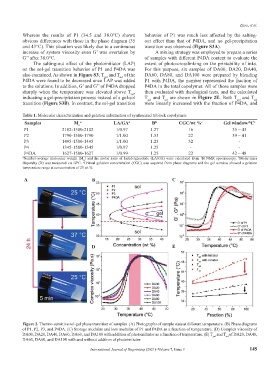
           Whereas  the  results  of  P1  (34.5  and  38.0°C)  shown   behavior  of  P1  was  much  less  affected  by  the  salting-
           obvious differences with those in the phase diagram (35   out  effect  than  that  of  P4DA,  and  no  gel-precipitation
           and 43°C). This situation was likely due to a continuous   transition was observed (Figure S3A).
           increase of system viscosity even G’ was overtaken by   A mixing strategy was employed to prepare a series
           G’’ after 38.0°C.                                   of samples with different P4DA content to evaluate the
               The  salting-out  effect  of  the  photoinitiator  (LAP)   extent of photo-crosslinking on the printability of inks.
           on the sol-gel transition behavior of P1 and P4DA was   For this purpose, six samples of DA00, DA20, DA40,
           also examined. As shown in Figure S3, T  and T  of the   DA60,  DA80,  and DA100  were prepared by blending
                                                    sol
                                             gel
           P4DA were found to be decreased once LAP was added   P1 with P4DA, the number represented the fraction of
           to the solutions. In addition, G’ and G’’ of P4DA dropped   P4DA in the total copolymer. All of those samples were
           sharply  when the  temperature was elevated  above  T ,   then evaluated with rheological tests, and the calculated
                                                         sol
           indicating a gel-precipitation process instead of a gel-sol   T  and T  are shown in Figure 2E. Both T  and T
                                                                gel
                                                                                                             sol
                                                                                                      gel
                                                                       sol
           transition (Figure S3B). In contrast, the sol-gel transition   were linearly increased with the fraction of P4DA, and
           Table 1. Molecular characterization and gelation information of synthesized triblock copolymers
            Samples              M n a           LA/GA  a         Ð b        CGC/wt %  c        Gel window/°C c
           P1              2102-1500-2102         1/0.97         1.27            16                 35 – 43
           P2              1790-1500-1790         1/1.00         1.33            22                 39 – 41
           P3              1495-1500-1495         1/1.00         1.23            32                    -
           P4              1345-1500-1345         1/0.97         1.23             -                    -
           P4DA            1627-1500-1627         1/0.99         1.25            22                 42 – 48
           a Number-average  molecular  weight (M ) and the molar ratio of lactide/glycolide  (LA/GA) were calculated  from  H NMR spectroscopy.  Molar-mass
                                                                                      1
                                                                                                      b
                                    n
           dispersity (Đ) was measured via GPC.  Critical gelation concentration (CGC) was acquired from phase diagrams and the gel window showed a gelation
                                    c
           temperature range at concentration of 25 wt.%
           A                            B                                 C


                                        D                                 E


           Figure 2. Thermo-sensitive sol-gel phase transition of samples. (A) Photographs of sample state at different temperature. (B) Phase diagrams
           of P1, P2, P3, and P4DA. (C) Storage modulus and loss modulus of P1 and P4DA as a function of temperature. (D) Complex viscosity of
           DA00, DA20, DA40, DA60, DA60, and DA100 with addition of photoinitiator as a function of temperature. (E) T  and T of DA20, DA40,
                                                                                           gel
                                                                                                 sol
           DA60, DA60, and DA100 with and without addition of photoinitiator.
                                       International Journal of Bioprinting (2021)–Volume 7, Issue 3       145

