


Page 53 - IJB-7-4
P. 53
Lin, et al.
           and in vivo experiments showed that new osteogenesis   to determine the optimal printing parameters, selecting a
           could  be  observed  on  PCL+β-TCP,  PCL+  β-TCP+M   rod structure with a pore size at 600 μm to maintain the
           scaffolds, and the largest area of new osteogenesis was   properties of most raw material, and the experimental
           observed on the PCL+β-TCP+M scaffolds.              results showed that the scaffold promoted the proliferation
                                                               of  bone  marrow  stromal  cells  in  vitro  and  could  be
           3.2. Double layer structure                         incubated  for  7  days  with  significantly  higher  levels  of
                                                               osteogenic gene transcription than the blank control.
           In contrast to the classic support structure in the previous   Shao  et al. [91]  investigated  the  effect  of  one-step/two-
           section, the two-layer structure can be realized by adjusting   step sintering method on the physicochemical properties
           the printing parameters based on single-layer printing. That   of  Mg  ion-doped  CS  scaffolds  on  the  basis  of  bilayer
           is, the printhead prints two layers in the same direction   printing (Figure 2B), the bilayer scaffolds had increased
           and then switches the angle and repeats the print. Unlike   degradation rate due to their large pore diameter but
           the single-layer structure printing, multi-material can only   slightly weaker compressive properties than the monolayer
           be printed by the way of mechanical mixing of the paste   scaffolds,  and  then  the  two-step  sintering  significantly
           before printing, and double-layer printing can be achieved   improved  the  scaffold  compressive  strength  (~25104
           through  multi-jet  printing  or  direct  stacking  method  to   MPa) and flexural strength (~618 MPa). Jin et al.  doped
                                                                                                       [92]
           avoid the degradation of material properties caused by the   calcium silicate powders with different mass fractions of
           mixing of multiple pastes.                          Mg ions and used a bilayer printing (Figure 2C), and its
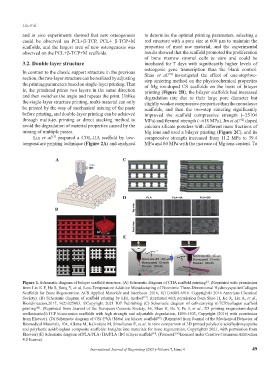
               Lin  et al.   prepared  a  COL-HA  scaffold  by  low-  compressive  strength  increased  from  11.2  MPa  to  39.4
                       [5]
           temperature printing technique (Figure 2A) and analyzed   MPa and 80 MPa with the increase of Mg ions content. To


                         A                           C


                                                     D

                        B


                                                     E


           Figure 2. Schematic diagram of bilayer scaffold structure. (A) Schematic diagram of CHA scaffold printing . (Reprinted with permission
                                                                                         [5]
           from Lin K F, He S, Song Y, et al. Low-Temperature Additive Manufacturing of Biomimic Three-Dimensional Hydroxyapatite/Collagen
           Scaffolds for Bone Regeneration. ACS Applied Materials and Interfaces. 2016; 8(11):6905-6916. Copyright© 2016 American Chemical
           Society). (B) Schematic diagram of scaffold printing by LBL method . Reprinted with permission from Shao H, Ke X, Liu A, et al.,
                                                              [91]
           Biofabrication,2017;  9(2):025003,  ©Copyright  2021  IOP  Publishing  (C)  Schematic  diagram  of  cell-carrying  α-TCP/collagen  scaffold
           printing . (Reprinted from Journal of the European Ceramic Society, 36, Shao H, He Y, Fu J, et al., 3D printing magnesium-doped
                [92]
           wollastonite/β-TCP bioceramics scaffolds with high strength and adjustable degradation, 1495-1503, Copyright (2016) with permission
           from Elsevier). (D) Schematic diagram of CSi+PVA+Metal ion bilayer scaffold . (Reprinted from Journal of the Mechanical Behavior of
                                                                    [93]
           Biomedical Materials, 104, Alksne M, Kalvaityte M, Simoliunas E, et al. In vitro comparison of 3D printed polylactic acid/hydroxyapatite
           and polylactic acid/bioglass composite scaffolds: Insights into materials for bone regeneration, Copyright© 2021, with permission from
           Elsevier) (E) Schematic diagram of PLA/PLA+HA/PLA+BG bilayer scaffold . (From ref.  licensed under Creative Commons Attribution
                                                                            [94]
                                                                  [94]
           4.0 license).
                                       International Journal of Bioprinting (2021)–Volume 7, Issue 4        49

