


Page 161 - IJB-8-2
P. 161
Wang, et al.
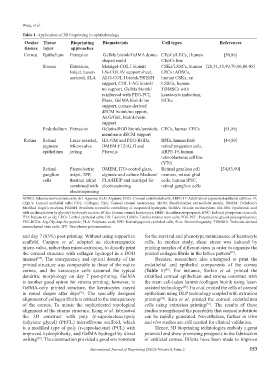
           Table 1. Application of 3D bioprinting in ophthalmology
           Ocular  Tissue      Bioprinting   Biomaterials             Cell types              References
           tissues  layer      approaches
           Cornea  Epithelium  Extrusion     GelMa bioink/GelMA dome- CEpCs/LECs, Human         [50,86]
                                            shaped mold               CEpCs line
                   Stroma      Extrusion,   Matrigel-COL I bioink/    CSKs/LSSCs, human  [28,31,35,49,79,80,86-88]
                               Inkjet, Laser-  LN-COL IV support sheet,   LECs+ADSCs,
                               assisted, SLA  ALG-COL I bioink/FRESH   human CSKs, rat
                                            support, COL I-AG bioink/   LSSCs, human
                                            no support, GelMa bioink/  TDMSCs with
                                            reinforced with PEG-PCL   keratocyte induction,
                                            fibers, GelMA bioink/ no   HCKs
                                            support, cornea-derived
                                            dECM bioink/no spport,
                                            ALG/GEL bioink/resin
                                            support
                   Endothelium Extrusion    Gelatin-RGD bioink/amniotic  CECs, human CECs       [51,86]
                                            membrane dECM support
           Retina  Retinal     Laser-assisted,  HA-GM and PEG-RGDs,   RPEs, human fetal         [44,89]
                   pigment     Microvalve   DMEM:F12/ALG and          retinal progenitor cells,
                   epithelium  jetting      Pluronic                  ARPE-19, human
                                                                      retinoblastoma cell line
                                                                      (Y79)
                   Retinal     Piezoelectric   DMEM, ITO-coated glass,   Retinal granlion cell   [54,83,90]
                   ganglion    inkjet, 2PP,   alginate and culture Medium/ neurons, retinal glial
                   cells       thermal inkjet  PLA/HEIP and matrigel for   cells, human iPSC,
                               combined with  electrospinning         retinal ganglion cells
                               electrospinning
           ADSCs: Adipose-derived stem cells; AG: Agarose; ALG: Alginate; CECs: Corneal endothelial cells; ARPE-19: Adult retinal pigmented epithelial cell line-19;
           CEpCs:  Corneal  epithelial  cells;  COL:  Collagen;  CSK: Corneal  stromal  keratocytes;  dECM:  Decellularized  extracellular  matrix;  DMEM: Dubelcco’s
           Modified Eagle’s medium; FRESH: Freeform reversible embedding of suspended hydrogels; GelMA: Gelatin methacrylate; HA-GM: Hyaluronic acid
           with methacrylation by glycidyl-hydroxyl reaction; HCKs: Human corneal keratocytes; HEIP: Hexafluoroisopropanol; iPSC: Induced pluripotent stem cell;
           ITO: Indium tin oxide; LECs: Limbal epithelial cells; LN: Laminin; LSSCs: Limbal stromal stem cells; PEG-PCL: Polyethylene glycol-polycaprolactone;
           PEG-RGDs: Arg-Gly-Asp-Ser peptide; PLA: Polylactic acid; RPE: Retinal pigment epithelial cells; SLA: Stereolithography; TDMSCs: Turbinate-derived
           mesenchymal stem cells; 2PP: Two-photon polymerization
           and day 7 (83%) post-printing. Without using supportive   for the survival and phenotype maintenance of keratocyte
           scaffold,  Campos  et al. adopted an electromagnetic   cells.  In another  study, shear stress was induced  by
           micro-valve, rather than micro-extrusion, to directly print   printing nozzles of different sizes in order to organize the
           the corneal structure with collagen hydrogel in a DOD   printed collagen fibrils in the lattice pattern .
                                                                                                   [79]
           manner . The  transparency  and  optical  density  of the   Besides, researchers also attempted to print the
                 [77]
           printed structure was comparable to those of the native   endothelial  and epithelial  components of the cornea
           cornea,  and the keratocyte  cells assumed the typical   (Table  1) . For instance, Sorkio  et  al. printed  the
                                                                       [45]
           dendritic  morphology  on day 7 post-printing.  GelMA   stratified  corneal  epithelium  and  stroma  construct  with
           is another good option for stroma printing; however, in   the stem cell-laden laminin/collagen bioink using laser-
           GelMA-only printed  structure, the  keratocytes  stayed   assisted technology . Jin et al. printed the cells of corneal
                                                                               [28]
           in  round shapes after  days .  The  specially  designed   epithelium using DLP technology coupled with extrusion
                                   [35]
           alignment of collagen fibrils is critical to the transparency   printing . Kim  et  al. printed the  corneal  endothelium
                                                                     [50]
           of the cornea.  To mimic  the  sophisticated  topological   cells using extrusion printing .  The results of these
                                                                                         [51]
           alignment of the stroma structure, Kong et al. fabricated   studies strengthened the possibility that corneal substitute
           the  3D construct  with  poly  (ε-caprolactone)-poly   can be rapidly generated. Nevertheless, further in vitro
           (ethylene  glycol)  (PECL)  microfibrous  scaffold,  which   and vivo studies are still needed for clinical validation.
           is a modified type of poly (ε-caprolactone) (PCL) with   Hence, 3D bioprinting technologies embody a great
           improved hydrophilicity, and GelMA hydrogel by direct   potential and show promising prospects in the fabrication
           writing . The construction provided a good environment   of artificial cornea. Efforts have been made to improve
                 [78]
                                       International Journal of Bioprinting (2022)–Volume 8, Issue 2       153

