


Page 238 - IJB-8-4
P. 238
3DP PEEK implants for chest wall reconstruction
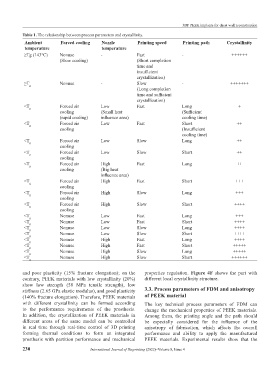
           Table 1. The relationship between process parameters and crystallinity.
           Ambient         Forced cooling   Nozzle          Printing speed     Printing path     Crystallinity
           temperature                      temperature
           ≥Tg (143℃)     Nonuse            -              Fast               -                    ++++++
                          (Slow cooling)                   (Short completion
                                                           time and
                                                           insufficient
                                                           crystallization)
           ≥T             Nonuse            -              Slow               -                    +++++++
              g
                                                           (Long completion
                                                           time and sufficient
                                                           crystallization)
           <T g           Forced air        Low            Fast               Long                    +
                          cooling           (Small heat                       (Sufficient
                          (rapid cooling)   influence area)                   cooling time)
           <T g           Forced air        Low            Fast               Short                   ++
                          cooling                                             (Insufficient
                                                                              cooling time)
           <T             Forced air        Low            Slow               Long                    ++
              g
                          cooling
           <T g           Forced air        Low            Slow               Short                   ++
                          cooling
           <T             Forced air        High           Fast               Long                    ++
              g
                          cooling           (Big heat
                                            influence area)
           <T g           Forced air        High           Fast               Short                  +++
                          cooling
           <T g           Forced air        High           Slow               Long                   +++
                          cooling
           <T             Forced air        High           Slow               Short                  ++++
              g
                          cooling
           <T g           Nonuse            Low            Fast               Long                   +++
           <T g           Nonuse            Low            Fast               Short                  ++++
           <T g           Nonuse            Low            Slow               Long                   ++++
           <T g           Nonuse            Low            Slow               Short                  ++++
           <T g           Nonuse            High           Fast               Long                   ++++
           <T g           Nonuse            High           Fast               Short                 +++++
           <T g           Nonuse            High           Slow               Long                  +++++
           <T g           Nonuse            High           Slow               Short                ++++++


           and poor plasticity (15% fracture elongation); on the   properties  regulation.  Figure  4F  shows  the  part  with
           contrary, PEEK materials with low crystallinity (20%)   different local crystallinity structure.
           show low strength (58 MPa tensile strength), low
           stiffness (2.65 GPa elastic modulus), and good plasticity   3.3. Process parameters of FDM and anisotropy
           (140% fracture elongation). Therefore, PEEK materials   of PEEK material
           with  different  crystallinity  can  be  formed  according   The key technical process parameters of FDM can
           to the  performance requirements  of  the  prosthesis.   change the mechanical properties of PEEK materials.
           In addition, the crystallization of PEEK materials in   Among them, the printing angle and the path should
           different  areas  of  the  same  model  can  be  controlled   be  especially  considered  for  the  influence  of  the
           in real time through real-time control of 3D printing   anisotropy  of  fabrication,  which  affects  the  overall
           forming thermal conditions to form an integrated    performance and ability to apply the manufactured
           prosthesis with partition performance and mechanical   PEEK materials. Experimental results show that the

           230                         International Journal of Bioprinting (2022)–Volume 8, Issue 4

