


Page 239 - IJB-8-4
P. 239
Wang, et al.
           additive  manufactured  PEEK  has  different  anisotropy   FDM technology. Experimental results show that under
           with  different  layer  thickness  and  printing  angle,  and   the layer thickness of 0.2  mm, the printing speed of
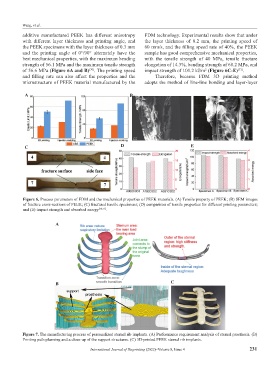
           the PEEK specimens with the layer thickness of 0.3 mm   60 mm/s, and the filling speed rate of 40%, the PEEK
           and  the  printing  angle  of  0°/90°  alternately  have  the   sample has good comprehensive mechanical properties,
           best mechanical properties, with the maximum bending   with the tensile strength of 40 MPa, tensile fracture
           strength of 56.1 MPa and the maximum tensile strength   elongation of 14.3%, bending strength of 68.2 MPa, and
           of 56.6 MPa (Figure 6A and B) [70] . The printing speed   impact strength of 101.2 kJ/m  (Figure 6C-E) [71] .
                                                                                        2
           and  filling  rate  can  also  affect  the  properties  and  the   Therefore,  because  FDM 3D printing  method
           microstructure of PEEK material manufactured by the   adopts the method of line-line bonding and layer-layer

            A                                           B


            C                                       D                             E


           Figure 6. Process parameters of FDM and the mechanical properties of PEEK materials. (A) Tensile property of PEEK; (B) SEM images
           of fracture cross-sections of PEEK; (C) fractured tensile specimens; (D) comparison of tensile properties for different printing parameters;
           and (E) impact strength and absorbed energy [70,71] .


                         A


                         B                                                C


           Figure 7. The manufacturing process of personalized sternal rib implants. (A) Performance requirement analysis of sternal prosthesis. (B)
           Printing path planning and a close-up of the support structures. (C) 3D-printed PEEK sternal rib implants.

                                       International Journal of Bioprinting (2022)–Volume 8, Issue 4       231

