


Page 342 - IJB-8-4
P. 342
Three-Dimensional Printing Technologies for Drug Delivery Applications
           4.2. Topical dosage form                            mucosa or a vaginal epithelium, respectively, due to their
                                                               permeability to a range of substances . As with the 3D
                                                                                              [12]
           Topical delivery of drugs, also known as transdermal drug
           delivery, is the process of administering drugs on to the   scanned masks detailed in section 4.2, Sun et al. utilized
                                                               the  ability  of 3D printing  to  produce  customizable
           surface of the skin. Due to the high permeability of the skin,
           this often requires the assistance of a rate-controlling barrier   geometries  by using SLA technology, DLP, to print
           layer with lower permeability to prevent over-dosing .   molds of the rectal  and vaginal  suppository in which
                                                        [16]
                                                                                                            [90]
           Transdermal DDDs may come in the form of patches,   silicon polymers loaded with analgesics were adhered .
           masks, wound dressing, etc. Goyanes et al. compared the   Numerous studies have demonstrated the use of filament
           use of filament extrusion and SLA to incorporate anti-acne   extrusion techniques to 3D print  T-shaped intrauterine
           drug, salicylic acid, into a mask of the intended patients’   system  (IUS) devices,  which  are  regularly  used to
           nose attained through 3D scanning . Drug diffusion tests   administer long-lasting contraceptives, with materials
                                       [85]
           showed SLA to produce masks with slower degradation,   such as polycaprolactone and ethylene vinyl acetate.
           higher drug loading (1.9% w/w compared to 0.4–1.2% w/w   Details are shown in Table 11.
           for FDM) and higher dimensional accuracy . Later,   4.4. Parenteral dosage form
                                                  [85]
           the same research group continued to print 3D-scanned
           masks as drug-delivering wound dressings, adding    Parenteral dosage form is the injection of drugs through
           antimicrobial metals including zinc, copper, and silver into   subcutaneous, intramuscular, intravenous, or intra-arterial
           polycaprolactone to better aid wound healing .      routes. This dosage form allows the rapid action of the
                                                [86]
               A similar  concept  of using 3D scans of an     administered drug .
                                                                              [96]
           individual  to tailor  transdermal DDDs  was exhibited   To enhance the powerful delivery capabilities
           by Wei et al., who demonstrated the ability to produce   of needles, smaller devices were created  known as
           a face mask based on a pre-scanned file of the patient’s   microneedles,  which  are  large  enough  to  contain
           face, a mask was created using a medical-grade silicone   the drug but small  enough to avoid pain and fear .
                                                                                                            [97]
           gel and a transparent biocompatible  material,  for a   Taking  advantage  of 3D printing,  Pere  et  al. used
           20-h/day treatment of facial hypertrophic scars . More   stereolithography  technology  to  create  pyramid  and
                                                   [87]
           information of studies about topical dosage form using   cone microneedles with a coat of insulin formulations .
                                                                                                            [98]
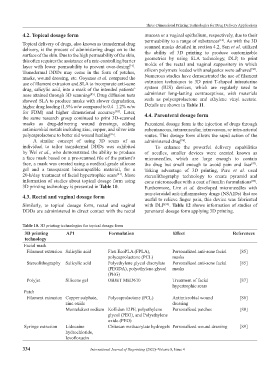
           3D printing technology is presented in Table 10.    Furthermore,  Lim  et  al.  developed  microneedles  with
                                                               non-steroidal anti-inflammatory drugs (NSAIDs) that are
           4.3. Rectal and vaginal dosage form                 useful to relieve finger pain, this device was fabricated
           Similarly, to topical  dosage form, rectal  and vaginal   with DLP . Table 12 shows information of studies of
                                                                       [99]
           DDDs are administered in direct contact with the rectal   parenteral dosage form applying 3D printing.

           Table 10. 3D printing technologies for topical dosage form
            3D printing      API               Formulation                 Effect                   References
            technology
           Facial mask
            Filament extrusion Salicylic acid   Flex EcoPLA (FPLA),       Personalized anti-acne facial   [85]
                                               polycaprolactone (PCL)     masks
            Stereolithography  Salicylic acid  Polyethylene glycol diacrylate   Personalized anti-acne facial   [85]
                                               (PEGDA), polyethylene glycol   masks
                                               (PEG)
            Polyjet          Silicone gel      OBJET MED610               Treatment of facial          [87]
                                                                          hypertrophic scars
           Patch
            Filament extrusion Copper sulphate,   Polycaprolactone (PCL)  Antimicrobial wound          [86]
                             zinc oxide                                   dressing
                             Montelukast sodium Kollidon 12PF, polyethylene   Personalized patches     [88]
                                               glycol (PEG), and Polyethylene
                                               oxide (PEO)
           Syringe extrusion  Lidocaine        Chitosan methacrylate hydrogels Personalized wound dressing  [89]
                             hydrochloride,
                             levofloxacin

           334                         International Journal of Bioprinting (2022)–Volume 8, Issue 4

