


Page 391 - IJB-9-2
P. 391
International Journal of Bioprinting                               In situ 3D bioprinter for skin wound healing


                         A                                            B


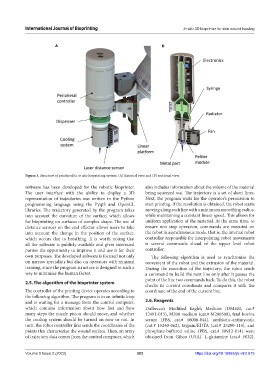
            Figure 3. Structure of printhead in in situ bioprinting system: (А) External view and (B) sectional view.

            software has been  developed for the robotic  bioprinter.   also includes information about the volume of the material
            The user interface  with the  ability to  display a 3D   being squeezed out. The trajectory is a set of short lines.
            representation of trajectories was written in the Python   Next, the program waits for the operator’s permission to
            programming language using the Pyqt5 and OpenGL    start printing. If the resolution is obtained, the robot starts
            libraries. The trajectory generated by the program takes   moving along each line with a minimum smoothing radius,
            into account the curvature of the surface, which allows   while maintaining a constant linear speed. This allows for
            for bioprinting on surfaces of complex shape. The use of   uniform application of the material. At the same time, to
            distance sensors on the end effector allows users to take   ensure  non-stop  operation,  commands  are executed  on
            into account the change in the position of the surface,   the robot in asynchronous mode, that is, the internal robot
            which occurs due to breathing. It is worth noting that   controller responsible for interpolating robot movements
            all the software is publicly available and gives interested   is several commands ahead of the upper level robot
            parties the opportunity to improve it and use it for their   controller.
            own purposes. The developed software is focused not only   The following algorithm is used to synchronize the
            on narrow specialists but also on operators with minimal   movement of the robot and the extrusion of the material.
            training, since the program structure is designed in such a   During the execution of the trajectory, the robot sends
            way to minimize the human factor.                  a command to build the next line only after it passes the
                                                               point of the line two commands back. To do this, the robot
            2.5. The algorithm of the bioprinter system
                                                               checks  its  current coordinate and compares  it  with  the
            The controller of the printing device operates according to   coordinate of the end of the current line.
            the following algorithm. The program is in an infinite loop
            and is waiting for a message from the control computer,   2.6. Reagents
            which  contains  information  about  how  fast  and  how   Dulbecco’s Modified Eagle’s Medium (DMEM, cat.#
            many steps the nozzle piston should move, and whether   12491-015), M200 medium (cat.# M200500), fetal bovine
            the cooling system should be turned on now or not. In   serum (FBS, cat.# 16000-044), antibiotic-antimycotic
            turn, the robot controller first sends the coordinates of the   (cat.# 15240-062), trypsin/EDTA (cat.# 25200-114), and
            points that characterize the wound surface. Then, an array   phosphate-buffered saline (PBS, cat.# 18912-014) were
            of trajectory data comes from the control computer, which   obtained from Gibco (USA). L-glutamine (cat.# F032),


            Volume 9 Issue 2 (2023)                        383                      https://doi.org/10.18063/ijb.v9i2.675

