


Page 393 - IJB-9-2
P. 393
International Journal of Bioprinting                               In situ 3D bioprinter for skin wound healing


            In  vivo experiments were performed at the Veterinary   glasses, and routinely stained with hematoxylin-eosin dye
            Department of the National Medical Research Center   (BioVitrum, Russia).
            for Radiology and were approved by the local ethics   Morphometry histological sections were performed
            committee (protocol #0120/19 dated November 1, 2019).   using  automated  image  analysis  system  (ImageJ, USA)
            Throughout the experiment, the animals were kept in   and quantitative morphometric parameters such as
            individual ventilated boxes under exhaust ventilation and   inflammatory index  (number  of  inflammatory  cells  per
            were fed ad libitum. The animal work was carried out in   unit of analyzed histological section area) and angiogenesis
            accordance with the ethical principles established by the   index (number of microvessels profile per unit of analyzed
            European Convention for the Protection of Vertebrate   histological section area) were estimated with sequential
            Animals used for Experimental and Other Scientific   statistical analysis.
            Purposes (Strasbourg, 2006) and the International
            Guidelines for Biomedical Research in Animals (CIOMS   2.15. Statistical analysis
            and ICLAS, 2012). Circular full-thickness skin defects were   Statistical data were analyzed and  graphs were plotted
            formed using sterile surgical instruments after preliminary   using GraphPad Prism software (GraphPad Software, Inc.,
            intravenous Zoletil/Xylazine sedation of animals. In the   La Jolla, CA) and expressed in mean ± standard deviation.
            case  of minipigs, the isoflurane inhalation anesthesia   The Mann–Whitney U-test was used to compare the
            was additionally used. Robotic-assisted bioprinting with   quantitative characteristics of the groups. Statistical
            hydrogel compositions was carried out immediately after   significance was determined at P < 0.05.
            the wound preparation and cleaning. The polymerized
            bioprinted collagen hydrogels  in  wounds were  carefully   3. Results
            covered with dressings. All animals received intramuscular
            antimicrobial and analgesic drugs for 1 week after surgery.  3.1. Feedback system
                                                               Since the patient is breathing during bioprinting, it is
            2.13. Adhesiometric analysis
                                                               necessary to  take  into  account  the displacement  of  the
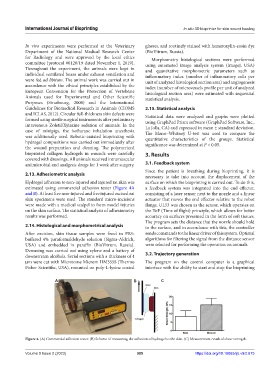
            Hydrogel adhesion to non-injured and injured rat skin was   surface on which the bioprinting is carried out. To do this,
            estimated using commercial adhesion tester (Figure  4A   a feedback system was integrated into the end effector,
            and B). At least five non-injured and five injured excised rat   consisting of a laser sensor next to the nozzle and a linear
            skin specimens were used. The standard micro-incisions   actuator that moves the end effector relative to the robot
            were made with a medical scalpel to form model injuries   flange. UL53 was chosen as the sensor, which operates on
            on the skin surface. The statistical analysis of adhesiometry   the ToF (Time of flight) principle, which allows for better
            results was performed.                             accuracy on surfaces presented in the form of soft tissues.
                                                               The program sets the distance that the nozzle should hold
            2.14. Histological and morphometrical analysis     to the surface, and in accordance with this, the controller
            After excision, skin tissue samples were fixed in PBS-  sends commands to the linear driver of this system. Optimal
            buffered  4% paraformaldehyde solution  (Sigma-Aldrich,   algorithms for filtering the signal from the distance sensor
            USA) and embedded in paraffin (BioVitrum, Russia).   were selected for performing the operation on animals.
            Dewaxing was carried out using xylene and a battery of
            downstream alcohols. Serial sections with a thickness of 4   3.2. Trajectory generation
            μm were cut with Microtome Microm HM355S (Thermo   The program on the control computer is a  graphical
            Fisher Scientific, USA), mounted on poly-L-lysine coated   interface with the ability to start and stop the bioprinting


                         A                                B           C


            Figure 4. (A) Commercial adhesion tester. (B) Scheme of measuring the adhesion of hydrogel to the skin. (C) Measurement result of shear strength.


            Volume 9 Issue 2 (2023)                        385                      https://doi.org/10.18063/ijb.v9i2.675

