


Page 397 - IJB-9-2
P. 397
International Journal of Bioprinting                               In situ 3D bioprinter for skin wound healing


                         A                                   B


                         C                      D                         E


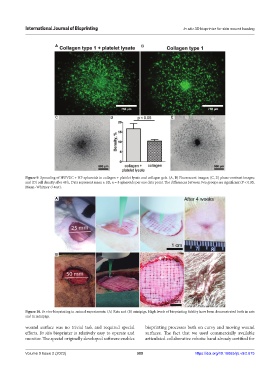
            Figure 9. Spreading of HUVEC + HF spheroids in collagen + platelet lysate and collagen gels. (A, B) Fluorescent images; (C, E) phase-contrast images;
            and (D) cell density after 48 h. Data represent mean ± SD, n = 8 spheroids per one data point. The differences between two groups are significant (P < 0.05,
            Mann–Whitney U-test).

                         A


                         B


            Figure 10. In vivo bioprinting in animal experiments: (A) Rats and (B) minipigs. High levels of bioprinting fidelity have been demonstrated both in rats
            and in minipigs.

            wound surface was no trivial task and required special   bioprinting processes both on curvy and moving wound
            efforts. In situ bioprinter is relatively easy to operate and   surfaces. The fact that we used commercially available
            monitor. The special originally developed software enables   articulated collaborative robotic hand already certified for


            Volume 9 Issue 2 (2023)                        389                      https://doi.org/10.18063/ijb.v9i2.675

