


Page 417 - IJB-9-2
P. 417
International Journal of Bioprinting Design and 3D printing of TPMS breast scaffolds
Triply periodic minimal surfaces (TPMS) are fully model, respectively, and the scaffold structure was
connected structures with continuous surfaces and self- further optimized according to the simulation results.
supporting ability. The common TPMS units include Subsequently, the optimized TPMS scaffold was printed
[41]
Gyroid, Diamond, I-WP, and Primitive. . Due to its by biodegradable PCL through FDM. PEGDA/GelMA
excellent mechanical properties, large specific surface was used to prepare hydrogel solution, and then hADSCs
area, and super connectivity, TPMS provides a good were added into the hydrogel solution. After that, the
environment for cell growth and tissue regeneration and hydrogel solution containing cells was perfused into the
is ideal tissue scaffolds in tissue engineering, especially printed TPMS scaffold, and finally the hydrogel solution
in bone tissue engineering. For instance, Ma et al. was solidified under ultraviolet light to fabricate the TPMS
[42]
printed the Gyroid bone scaffolds with different volume scaffold loaded with hydrogel with bioactivity.
fractions and the mechanical properties of the Gyroid 2.2. Design of TPMS scaffold
scaffold matched that of human bone by changing
porosity. Although the mechanical properties of TPMS TPMS scaffolds were designed in MSLattice (Open-
[43]
can be modified to a strong level to match hard tissues, it is source software from Dr. Oraib Al Ketan ). The STL files
challenging to adjust the mechanical properties of TPMS to generated by MSLattice were converted into CAD files by
a soft state to meet the requirements of breast tissue due to Geomagic Wrap (3D System, USA), and then the TPMS
the intrinsic continuous structure of TPMS. Thus, in breast scaffolds were modified and optimized in UG NX10.0
tissue engineering, TPMS is hardly harnessed to fabricate (Siemens PLM Software, USA).
breast scaffolds due to its unmatched high elastic modulus 2.2.1. Unit structures
with native breast tissue. Therefore, the optimization of
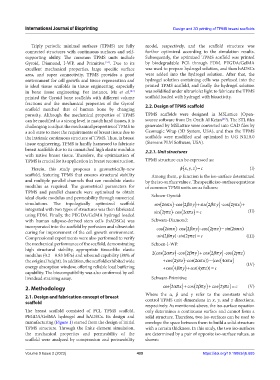
TPMS is crucial for its application in breast reconstruction. TPMS structure can be expressed as:
(
Herein, this study proposes a geometrically-new xy z,, ) = c (I)
scaffold, featuring TPMS that ensures structural stability Among them, φ function is the iso-surface determined
and multiple parallel channels that can modulate elastic by the iso-surface value c. The specific iso-surface equations
modulus as required. The geometrical parameters for of common TPMS units are as follows:
TPMS and parallel channels were optimized to obtain
ideal elastic modulus and permeability through numerical Schoen-Gyroid:
(
simulations. The topologically optimized scaffold sin 2απ x)⋅cos ( 2βπ y) + ( 2βπ y)⋅cos ( 2γπ z) +
sin
integrated with two types of structures was then fabricated ( 2γπ z)⋅cos ( 2απ x)) = c (II)
sin
using FDM. Finally, the PEGDA/GelMA hydrogel loaded
with human adipose-derived stem cells (hADSCs) was Schwarz-Diamond:
incorporated into the scaffold by perfusion and ultraviolet cos 2απx)⋅ cos 2βπ y)⋅ cos 2γπz) − sin (2απx )
(
(
(
curing for improvement of the cell growth environment.
)⋅
⋅
Compressional experiments were also performed to verify sin (2βπ y sin (2γπz)) = c (III)
the mechanical performance of the scaffold, demonstrating Schoen-I-WP:
high structural stability, appropriate tissue-like elastic 2(cos( cos( cos( cos( 2γπz)
modulus (0.2 – 0.83 MPa) and rebound capability (80% of 2απx)⋅ 2βπ y) + 2βπ y)⋅
the original height). In addition, the scaffold exhibited wide + cos( 2γπz)⋅cos 2 ( αππx)) (− cos(4 απx)
energy absorption window, offering reliable load buffering + cos(4 βπ y) + cos(4 γπz)) = c (IV)
capability. The biocompatibility was also confirmed by cell
live/dead straining assay. Schwarz-Primitive:
(
(
(
2. Methodology cos 2απx) + cos 2βπ y) + cos 2γπz) = c (V)
2.1. Design and fabrication concept of breast Where the α, β and γ refer to the constants which
scaffold control TPMS unit dimensions in x, y, and z directions,
respectively. As mentioned above, the iso-surface equation
The breast scaffold consisted of PCL TPMS scaffold, only determines a continuous surface and cannot form a
PEGDA/GelMA hydrogel and hADSCs. Its design and solid structure. Therefore, two iso-surfaces can be used to
manufacturing (Figure 1) started from the design of initial envelope the space between them to build a solid structure
TPMS structure. Through the finite element simulation, with a certain thickness. In this study, the two iso-surfaces
the mechanical properties and permeability of the are determined by a pair of opposite iso-surface values, as
scaffold were analyzed by compression and permeability shown:
Volume 9 Issue 2 (2023) 409 https://doi.org/10.18063/ijb.685

