


Page 419 - IJB-9-2
P. 419
International Journal of Bioprinting                           Design and 3D printing of TPMS breast scaffolds


                         A


                         B                                    C


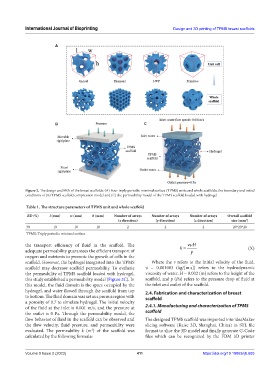
            Figure 2. The design and FEA of the breast scaffolds: (A) Four triply periodic minimal surface (TPMS) units and whole scaffolds; the boundary and initial
            conditions of (B) TPMS scaffold compression model and (C) the permeability model of the TPMS scaffold loaded with hydrogel.

            Table 1. The structure parameters of TPMS unit and whole scaffold

             RD (%)   l (mm)   w (mm)   h (mm)    Number of arrays   Number of arrays   Number of arrays   Overall scaffold
                                                   (x direction)   (y direction)   (z direction)   size (mm )
                                                                                                          3
            30          10       10       10           2               2               2            20*20*20
            TPMS: Triply periodic minimal surface

            the transport efficiency of fluid in the scaffold. The            k = νυ H
            adequate permeability guarantees the efficient transport of           p                        (X)
            oxygen and nutrients to promote the growth of cells in the
            scaffold. However, the hydrogel integrated into the TPMS   Where the ν refers to the initial velocity of the fluid,
            scaffold may decrease scaffold permeability. To evaluate   υ  =  0.001003 (kg/[m.s]) refers to the hydrodynamic
            the permeability of TPMS scaffold loaded with hydrogel,   viscosity of water, H = 0.002 (m) refers to the height of the
            this study established a permeability model (Figure 2C). In   scaffold, and p (Pa) refers to the pressure drop of fluid at
            this model, the fluid domain is the space occupied by the   the inlet and outlet of the scaffold.
            hydrogel, and water flowed through the scaffold from top   2.4. Fabrication and characterization of breast
            to bottom. The fluid domain was set as a porous region with   scaffold
            a porosity of 0.7 to simulate hydrogel. The initial velocity
            of the fluid at the inlet is 0.001 m/s, and the pressure at   2.4.1. Manufacturing and characterization of TPMS
            the outlet is 0 Pa. Through the permeability model, the   scaffold
            flow behavior of fluid in the scaffold can be observed and   The designed TPMS scaffold was imported into ideaMaker
            the flow velocity, fluid pressure, and permeability were   slicing  software (Raise  3D, Shanghai,  China)  in  STL  file
            evaluated. The permeability  k (m ) of the scaffold was   format to slice the 3D model and finally generate G-Code
                                        2
            calculated by the following formula:               files which can be recognized by the FDM 3D printer


            Volume 9 Issue 2 (2023)                        411                         https://doi.org/10.18063/ijb.685

