


Page 422 - IJB-9-2
P. 422
International Journal of Bioprinting                           Design and 3D printing of TPMS breast scaffolds


            weak resistance to deformation under load. Conversely,   largest and the amplitude is the smallest, so the fluctuation
            the elastic modulus of primitive is the lowest among the   range is narrow, which means the flow of fluid in the
            four TPMS scaffolds, and their elastic modulus are 18.67,   Gyroid is stable and gentle. In addition, the flow velocity is
            22.76, 23.38, and 13.97 MPa, respectively.         generally kept at a high level even at the outlet. In contrast,
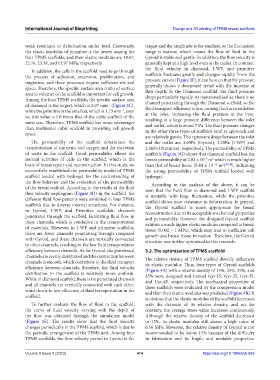
              In addition, the cells in the scaffold need to go through   the fluid velocity in diamond, I-WP, and primitive
            the process of adhesion, extension, proliferation, and   scaffolds fluctuates greatly and changes rapidly. From the
                                                               pressure curves (Figure 3F), it can be seen that the pressure
            migration, and these processes require sufficient site and   generally shows a  downward  trend  with  the increase  of
            space. Therefore, the specific surface area (ratio of surface   flow depth. In the Diamond scaffold, the fluid pressure
            area to volume) of the scaffold is important for cell growth.
            Among the four TPMS scaffolds, the specific surface area   drops particularly rapidly. As mentioned earlier, there is no
            of diamond is the largest, which is 2.97 mm  (Figure 3C),   channel penetrating through the Diamond scaffold, so the
                                               -1
            while the primitive is the smallest, which is 1.73 mm , even   fluid transport efficiency is low, causing fluid accumulation
                                                     -1
            so, this value is 5.8 times that of the cubic scaffold of the   at the inlet, increasing the fluid pressure at the inlet,
            same size. Therefore, TPMS scaffold has more advantages   resulting in a large pressure difference between the inlet
                                                               and outlet, which is about 7 Pa. The fluid pressure changes
            than traditional cubic scaffold in providing cell growth   in the other three types of scaffolds tend to approach and
            space.
                                                               are relatively gentle. Their pressure drops between the inlet
              The permeability of the scaffold determines the   and the outlet are 3.69Pa (Gyroid), 3.25Pa (I-WP) and
            transportation of nutrients and oxygen and the excretion   2.56Pa (Primitive), respectively. The permeability of TPMS
            of waste in the scaffold. Good permeability allows the   scaffolds (Figure 3G) shows that diamond scaffold has the
            normal  activities  of  cells  in  the  scaffold,  which  is  the   lowest permeability of 2.82 × 10  m  which is much higher
                                                                                        −9
                                                                                           2
            basis of breast repair and reconstruction. In this study, we   than that of breast tissue (5.44 × 10  m )  , indicating
                                                                                                2 [47,48]
                                                                                            −13
            successfully established the permeability model of TPMS   the strong permeability of TPSM scaffold loaded with
            scaffold loaded with hydrogel for the understanding of   hydrogel.
            the flow behavior and the evaluation of the permeability   According to the analysis of the above, it can be
            of the breast scaffold. According to the results of the fluid   seen that the fluid flow in diamond and I-WP scaffold
            flow velocity nephogram (Figure 3D) in the scaffold, the   is  unstable  with  large  fluctuation,  while  the  primitive
            different fluid flow patterns were exhibited in four TPMS   scaffold shows poor resistance to deformation. In general,
            scaffolds due to diverse internal structures. For instance,   the Gyroid scaffold is more appropriate for breast
            in Gyroid, I-WP, and Primitive scaffolds, channels   reconstruction due to its acceptable mechanical properties
            penetrated through the scaffold, facilitating fluid flow in   and permeability. However, the designed Gyroid scaffold
            these channels, which is conducive to the transportation   exhibits a much higher elastic modulus compared to breast
            of materials. However, in I-WP and primitive scaffolds,   tissue (0.002 – 1 MPa), which may lead to inefficient cell
            there  are fewer channels  penetrating  through  compared   growth and breast tissue formation. Therefore, the Gyroid
            with Gyroid, and these channels are vertically connected   structure was further optimized in this research.
            to other channels, resulting in the low fluid transportation
            efficiency between channels. As for Gyroid, the penetrated   3.2. The optimization of TPMS scaffold
            channels are evenly distributed and the connection between   The relative density of TPMS scaffold directly influences
            channels is smooth, which contribute to the fluid transport   its elastic modulus. Thus, four types of Gyroid scaffolds
            efficiency between channels; therefore, the fluid velocity   (Figure 4A) with a relative density of 15%, 25%, 35%, and
            distribution in the scaffold is relatively more uniform.   45% were designed and named Gyr-15, Gyr-25, Gyr-35,
            While in diamond scaffold, there is no penetrated channels   and Gyr-45,  respectively.  The mechanical  properties  of
            and all channels are vertically connected with each other,   these scaffolds were evaluated by the compression model
            which leads to low efficiency of fluid transportation in the   and then their elastic modulus was predicted (Figure 4B). It
            scaffold.                                          is obvious that the elastic modulus of the scaffold decreases
              To further evaluate the flow of fluid in the scaffold,   with the decrease of its relative density, and on the
            the curve of fluid velocity varying with the depth of   contrary, the average stress value increases continuously.
            the flow was obtained through the simulation model   Although the relative density of the scaffold decreased
            (Figure  3E).  The results  show that  the  fluid  velocity   to 15%, its elastic modulus still shows a high value of
            changes periodically in the TPMS scaffold, which is due to   6.56 MPa. However, the relative density of Gyroid is not
            the periodic arrangement of the TPMS unit. Among four   recommended to be below 15% because of the difficulty
            TPMS scaffolds, the flow velocity period in Gyroid is the   in  fabrication  and  its  fragile  and  unstable  properties.


            Volume 9 Issue 2 (2023)                        414                         https://doi.org/10.18063/ijb.685

