


Page 423 - IJB-9-2
P. 423
International Journal of Bioprinting                           Design and 3D printing of TPMS breast scaffolds


                         A                                            B


                         C                                            D


                         E                                     F


                        G                                      H


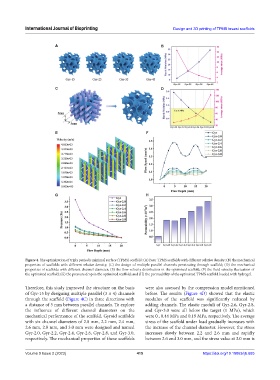
            Figure 4. The optimization of triply periodic minimal surface (TPMS) scaffold: (A) Four TPMS scaffolds with different relative density; (B) the mechanical
            properties  of  scaffolds  with  different  relative  density;  (C)  the  design  of  multiple  parallel  channels  penetrating  through  scaffold;  (D)  the  mechanical
            properties of scaffolds with different channel diameter; (E) the flow velocity distribution in the optimized scaffold; (F) the fluid velocity fluctuation of
            the optimized scaffold; (G) the pressure drop in the optimized scaffold; and (H) the permeability of the optimized TPMS scaffold loaded with hydrogel.


            Therefore, this study improved the structure on the basis   were also assessed by the compression model mentioned
            of Gyr-15 by designing multiple parallel (3 × 4) channels   before. The results (Figure  4D) showed that the elastic
            through the scaffold (Figure 4C) in three directions with   modulus of the scaffold was significantly reduced by
            a distance of 5 mm between parallel channels. To explore   adding channels. The elastic moduli of Gyr-2.6, Gyr-2.8,
            the influence of different channel diameters on the   and Gyr-3.0 were all below the target (1 MPa), which
            mechanical performance of the scaffold, Gyroid scaffolds   were 0., 0.44 MPa and 0.19 MPa, respectively. The average
            with six channel diameters of 2.0 mm, 2.2 mm, 2.4 mm,   stress of the scaffold under load gradually increases with
            2.6 mm, 2.8 mm, and 3.0 mm were designed and named   the increase of the channel diameter. However, the stress
            Gyr-2.0, Gyr-2.2, Gyr-2.4, Gyr-2.6, Gyr-2.8, and Gyr-3.0,   increases slowly between 2.2 and 2.6  mm and rapidly
            respectively. The mechanical properties of these scaffolds   between 2.6 and 3.0 mm, and the stress value at 3.0 mm is


            Volume 9 Issue 2 (2023)                        415                         https://doi.org/10.18063/ijb.685

