


Page 425 - IJB-9-2
P. 425
International Journal of Bioprinting                           Design and 3D printing of TPMS breast scaffolds


                         A                                     B


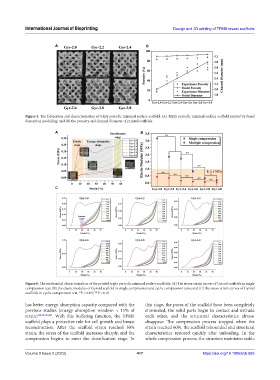
            Figure 5. The fabrication and characterization of triply periodic minimal surface scaffold: (A) Triply periodic minimal surface scaffold printed by fused
            deposition modelling; and (B) the porosity and channel diameter of printed scaffolds.
                         A                                   B


                         C


            Figure 6. The mechanical characterization of the printed triply periodic minimal surface scaffolds: (A) The stress-strain curves of Gyroid scaffolds in single
            compression test; (B) the elastic modulus of Gyroid scaffold in single compression and cyclic compression tests; and (C) the stress-strain curves of Gyroid
            scaffolds in cyclic compression test. *P < 0.05; **P < 0.01.

            has better energy absorption capacity compared with the   this stage, the pores of the scaffold have been completely
            previous  studies  (energy  absorption  window:  <  15%  of   eliminated, the solid parts begin to contact and extrude
            strain) [16,36,39,49] . With this buffering function, the TPMS   each other, and the structural characteristics almost
            scaffold plays a protective role for cell growth and breast   disappear. The  compression  process  stopped  when  the
            reconstruction. After the scaffold strain reached 50%   strain reached 60%, the scaffold rebounded and structural
            strain, the stress of the scaffold increases sharply, and the   characteristics  restored quickly after  unloading.  In the
            compression begins to enter the densification stage. In   whole compression process, the structure maintains stable


            Volume 9 Issue 2 (2023)                        417                         https://doi.org/10.18063/ijb.685

