


Page 426 - IJB-9-2
P. 426
International Journal of Bioprinting                           Design and 3D printing of TPMS breast scaffolds


            without any structural fracture or inclination, overcoming   all designed Gyroid scaffolds with channels meets the
            the contradiction between the low elastic modulus and the   requirements for elastic modulus in the actual use. On
            stability of breast scaffolds in the previous study . This is   the other hand, it can be seen from the cyclic compression
                                                  [32]
            consistent with the stress distribution results of the scaffold   curve that the rebound performance of the scaffolds after
            in the compression simulation. The deformation occurs in   compression remains highly consistent. At the beginning
            the high stress area, while the high stress areas of Gyroid   of every compression, the stress starts to rise when the
            are distributed uniformly on the surface inside the scaffold,   strain reaches about 20%, meaning that the rebound height
            resulting  in  the  uniform  deformation  of  Gyroid  scaffold   of the scaffold is 80% of the total height of the scaffold. It
            during compression process. Interestingly, although there   indicates that the scaffold has excellent height retention
            are defects described previously in the printed TPMS   characteristics, which were rarely reported.
            scaffolds, the mechanical properties are roughly coincident
            with the results predicted by simulation model, since these   3.4. The fabrication and characterization of TPMS
            defects only damaged the mechanical properties of the   scaffold loaded with hydrogel
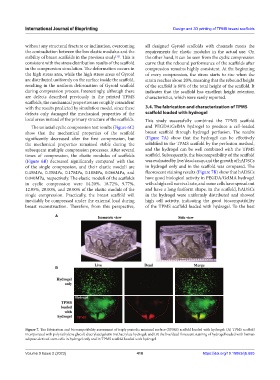
            local areas instead of the primary structure of the scaffolds.  This study successfully combined the TPMS scaffold
              The uniaxial cyclic compression test results (Figure 6C)   and PEGDA/GelMA hydrogel to produce a cell-loaded
            show that the mechanical properties of the scaffold   breast scaffold through hydrogel perfusion. The results
            significantly decreased after the first compression, but   (Figure  7A) show that the hydrogel can be effectively
            the mechanical properties remained stable during the   solidified in the TPMS scaffold by the perfusion method,
            subsequent multiple compression processes. After several   and the hydrogel can be well combined with the TPMS
            times of compression, the elastic modulus of scaffolds   scaffold. Subsequently, the biocompatibility of the scaffold
            (Figure  6B) decreased significantly compared with that   was evaluated by live/dead assay, and the growth of hADSCs
            of the single compression, and their elastic moduli are   in hydrogel only and in the scaffold was compared. The
            0.45MPa, 0.35MPa, 0.17MPa, 0.10MPa, 0.066MPa, and   fluorescent staining results (Figure 7B) show that hADSCs
            0.040MPa, respectively. The elastic moduli of the scaffolds   have good biological activity in PEGDA/GelMA hydrogel
            in cyclic compression were 14.20%, 18.72%, 9.77%,   with a high cell survival rate, and some cells have spread out
            12.05%, 20.00%, and 20.00% of the elastic moduli of the   and have a long fusiform shape. In the scaffold, hADSCs
            single compression. Practically, the breast scaffold will   in the hydrogel were uniformly distributed and showed
            inevitably be compressed under the external load during   high cell activity, indicating the good biocompatibility
            breast reconstruction. Therefore, from this perspective,   of the TPMS scaffold loaded with hydrogel. To the best

                         A


                         B


            Figure 7. The fabrication and biocompatibility assessment of triply periodic minimal surface (TPMS) scaffold loaded with hydrogel: (A) TPMS scaffold
            incorporated with poly (ethylene glycol) diacrylate/gelatin methacrylate hydrogel; and (B) the live/dead florescent staining of hydrogel loaded with human
            adipose-derived stem cells in hydrogel only and in TPMS scaffold loaded with hydrogel.


            Volume 9 Issue 2 (2023)                        418                         https://doi.org/10.18063/ijb.685

