


Page 421 - IJB-9-2
P. 421
International Journal of Bioprinting                           Design and 3D printing of TPMS breast scaffolds


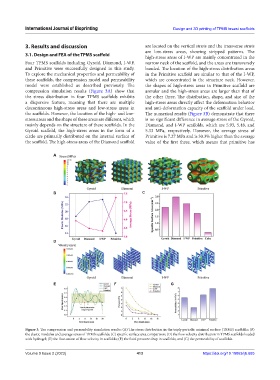
            3. Results and discussion                          are located on the vertical struts and the transverse struts
                                                               are low-stress  areas, showing stripped  patterns.  The
            3.1. Design and FEA of the TPMS scaffold           high-stress areas of I-WP are mainly concentrated in the
            Four TPMS scaffolds including Gyroid, Diamond, I-WP,   narrow neck of the scaffold, and the areas are transversely
            and Primitive were successfully designed in this study.   banded. The location of the high-stress distribution areas
            To explore the mechanical properties and permeability of   in the Primitive scaffold are similar to that of the I-WP,
            these scaffolds, the compression model and permeability   which are concentrated in the structure neck. However,
            model  were  established  as  described previously. The   the shapes of high-stress areas in Primitive scaffold are
            compression simulation results (Figure  3A) show that   annular and the high-stress areas are larger than that of
            the stress distribution in four TPMS scaffolds exhibits   the other three. The distribution, shape, and size of the
            a  dispersive  feature,  meaning  that  there  are  multiple   high-stress areas directly affect the deformation behavior
            discontinuous high-stress  areas  and low-stress areas  in   and anti-deformation capacity of the scaffold under load.
            the scaffolds. However, the location of the high- and low-  The numerical results (Figure 3B) demonstrate that there
            stress areas and the shape of these areas are different, which   is no significant difference in average stress of the Gyroid,
            mainly depends on the structure of these scaffolds. In the   Diamond, and I-WP scaffolds, which are 5.93, 5.48, and
            Gyroid scaffold, the high-stress areas in the form of a   5.33 MPa, respectively. However, the average stress of
            circle are primarily distributed on the internal surface of   Primitive is 7.27 MPa and is 30.3% higher than the average
            the scaffold. The high-stress areas of the Diamond scaffold   value of the first three, which means that primitive has

                        A


                        B                                     C


                        D


                        E                         F                       G


            Figure 3. The compression and permeability simulation results: (A) The stress distribution in the triply periodic minimal surface (TPMS) scaffolds; (B)
            the elastic modulus and average stress of TPMS scaffolds; (C) specific surface area comparison; (D) the flow velocity distribution in TPMS scaffolds loaded
            with hydrogel; (E) the fluctuation of flow velocity in scaffolds; (F) the fluid pressure drop in scaffolds; and (G) the permeability of scaffolds.


            Volume 9 Issue 2 (2023)                        413                         https://doi.org/10.18063/ijb.685

