


Page 431 - IJB-9-2
P. 431
International Journal of Bioprinting Shear-thinning and bioprinting parameters
currently not mature enough to printing structures for use These properties turn out to be very interesting for
in humans. Some of the most sought after applications are bioprinting. An ideal printable hydrogel should be highly
the bioprinting of skin [5,6] , heart tissue , vascular grafts , thixotropic, meaning that the viscosity of the hydrogel
[4]
[7]
cartilage , and hard tissues such as bone [9,10] . decreases rapidly when a shear force is applied, but recovers
[8]
In bioprinting techniques, generating the desired geometry rapidly after the shear force is removed. It is also important
in 3D models using tissue engineering is as important as cell to know how the viscosity behaves as the hydrogel dries
[31]
proliferation in the subsequent step, both of which are the before starting to print the next layer .
key to the survival of the printed tissue and its functional The viscoelastic behavior will favor the fluid’s
success. The selected bioprinting technology also influences maintaining the displacement properties typical of a fluid
the strategy taken to approach the bioprinting process and the while having the structural properties of an elastic solid. In
selection of the materials to be used. Bioprinting techniques this way, it will be capable of flowing when a deformation
are classified into inkjet, microextrusion (μ-extrusion), and force is applied, thus allowing the extrusion process to be
laser-assisted techniques . The most widely used by the achieved while also recovering part of the energy absorbed
[11]
scientific community is microextrusion , which is one of due to the characteristics of the elastic solid to form a
[12]
the reasons why this technology was chosen for simulation consistent 3D structure.
in the present study.
Shear-thinning fluids become less viscous when a
An important aspect of bioprinting process is to use deforming force is applied. This implies that when the
materials that allow the native extracellular matrix (ECM) hydrogel is subjected to pressure in the bioprinter, these
to be reproduced as a medium for cell development, that forces lead to a deformation in the fluid, reducing its
is, a medium that has the ideal biological, physical, and viscosity, and thus resulting in a fluid that flows more
mechanical properties for a good bioprinting process to take readily through the printing nozzle. Once the fluid has
place and finally that emulate the development of the desired been extruded, it is no longer subjected to the deformation
system. Specifically, the definition of bioink is attributed to a force and returns to its viscous consistency.
biomaterial that contains a certain cellular load.
Fluids with this shear-thinning property are governed
The materials most used as bioinks to make 3D by the mathematical model of the Ostwald–de Waele
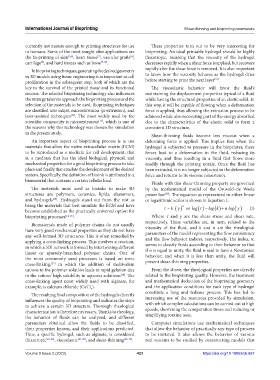
structures are polymers, ceramics, lipids, elastomers, power law . The equation as represented in either linear
[32]
and hydrogels . Hydrogels stand out from the rest as or logarithmic scales is shown in Equation I:
[13]
being the materials that best simulate the ECM and have or log log k (I)
n log
n
k
become established as the practically universal option for
bioprinting processes [14-16] . Where τ and γ are the shear stress and shear rate,
respectively. These variables are, in turn, related to the
Biomaterials made of polymer chains do not usually
have very good mechanical properties as they do not have viscosity of the fluid, and k and n are the rheological
parameters of the model representing the flow consistency
any well-formed 3D structures. This is often remedied by and the flow behavior indices, respectively. The index, n,
applying a cross-linking process. This involves a reaction, serves to classify fluids according to their behavior so that
in which a 3Dl network is formed by intertwining different if n is equal to unity, the fluid is said to have a Newtonian
linear or sparsely-branched polymer chains. One of behavior, and when it is less than unity, the fluid will
the most commonly used processes is based on ionic present shear-thinning properties.
cross-linking, in which the addition of multivalent
[17]
cations to the polymer solution leads to rapid gelation due From the above, the rheological properties are directly
to the cations’ high solubility in aqueous solutions . The related to the bioprinting quality. However, the treatment
[18]
cross-linking agent most widely used with alginate, for and mathematical deduction of the bioprinting geometry
example, is calcium chloride (CaCl ). and the application conditions for each type of hydrogel
2
The resulting final composition of the hydrogels directly constitute a long and tedious process. This has led to
influences the quality of bioprinting and indicates the steps increasing use of the resources provided by simulation,
to achieve a certain 3D structure. Thorough rheological with which complex calculations can be carried out at high
characterization is therefore necessary. Thanks to rheology, speeds, shortening the computation times and reducing or
the behavior of fluids can be analyzed, and different simplifying routine tests.
parameters obtained allow the fluids to be classified, Computer simulations use mathematical techniques
their properties known, and their applications predicted. that allow the behavior of practically any type of process
Thus, a specific hydrogel, such as alginate, is considered to be imitated. It also allows the behavior of various
thixotropic [19-22] , viscoelastic [23-25] , and shear-thinning [26-30] . real systems to be studied by constructing models that
Volume 9 Issue 2 (2023) 423 https://doi.org/10.18063/ijb.687

