


Page 435 - IJB-9-2
P. 435
International Journal of Bioprinting                               Shear-thinning and bioprinting parameters


            speed, the thinner the printing line that is deposited. For   3.3. Relationship between the rheology parameters
            this reason, the extrusion time at which the 3 mm height   and the bioprinting
            mark is reached (ordinate scale in Figure 6) was determined   Once  the  rheological  parameters  of  the  hydrogels  had
            for  samples  defined  with  the  pressures  set  so  that  they   been characterized and obtained (Table 2) and the values
            would result in similar geometries. It would then be found   related to bioprinting were found for similar extrusion of
            how much faster or slower the extrusion is performed, and   the different biomaterials (Table 3), the possible existence
            this could be related to the head’s speed of movement.
                                                               of a relationship between these was sought.
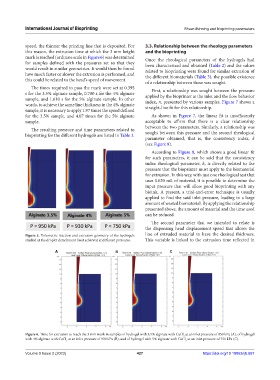
              The times required to pass the mark were set at 0.395
                                                                 First, a relationship was sought between the pressure
            s for the 3.5% alginate sample, 0.780 s for the 4% alginate   applied by the bioprinter at the inlet and the flow behavior
            sample, and 1.610 s for the 5% alginate sample. In other   index, n, presented by various samples. Figure 7 shows a
            words, to achieve the same line thickness in the 4% alginate   straight-line fit for this relationship.
            sample, it is necessary to apply 1.97 times the speed defined
            for the 3.5% sample, and 4.07 times for the 5% alginate   As shown in  Figure  7, the  linear fit is insufficiently
            sample.                                            acceptable to affirm that there is a clear relationship
                                                               between the two parameters. Similarly, a relationship was
              The resulting pressure and time parameters related to
            bioprinting for the different hydrogels are listed in Table 3.  sought between this pressure and the second rheological
                                                               parameter obtained, that is, the consistency index,  k
                                                               (see Figure 8).
                                                                 According to Figure 8, which shows a good linear fit
                                                               for such parameters, it can be said that the consistency
                                                               index rheological parameter,  k, is directly related to the
                                                               pressure that the bioprinter must apply to the biomaterial
                                                               for extrusion. In this way, with just one rheological test that
                                                               uses 0.620 mL of material, it is possible to determine the
                                                               input pressure that will allow good bioprinting with any
                                                               bioink. A  present, a trial-and-error technique is usually
                                                               applied to find the said inlet pressure, leading to a large
                                                               amount of wasted biomaterial. By applying the relationship
                                                               presented above, the amount of material and the time used
                                                               can be reduced.
                                                                 The second parameter that we intended to relate is
                                                               the dispensing head displacement speed that allows the
            Figure 5. Volumetric fraction and extrusion geometry of the hydrogels   line of extruded material to have the desired thickness.
            studied at the droplet detachment limit achieved at different pressures.  This variable is linked to the extrusion time reflected in

                         A                        B                      C


            Figure 6. Time for extrusion to reach the 3 mm mark in samples of hydrogel with 3.5% alginate with CaCl  at an inlet pressure of 950 kPa (A), of hydrogel
                                                                               2
            with 4% alginate with CaCl  at an inlet pressure of 930 kPa (B), and of hydrogel with 5% alginate with CaCl  at an inlet pressure of 750 kPa (C).
                                                                                2
                             2
            Volume 9 Issue 2 (2023)                        427                         https://doi.org/10.18063/ijb.687

