


Page 436 - IJB-9-2
P. 436
International Journal of Bioprinting                               Shear-thinning and bioprinting parameters


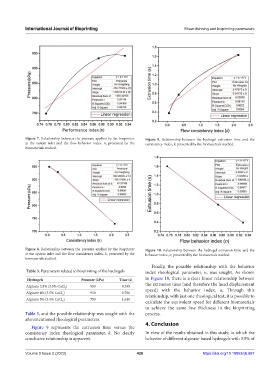
            Figure 7.  Relationship between the pressure applied by the bioprinter   Figure  9.  Relationship between the hydrogel extrusion time and the
            at the system inlet and the flow behavior index,  n, presented by the   consistency index, k, presented by the biomaterials studied.
            biomaterials studied.


            Figure 8.  Relationship between the pressure applied by the bioprinter   Figure  10.  Relationship between the hydrogel extrusion time and the
            at the system inlet and the flow consistency index, k, presented by the   behavior index, n, presented by the biomaterials studied.
            biomaterials studied.
                                                                 Finally, the possible relationship with the behavior
            Table 3. Parameters related to bioprinting of the hydrogels  index rheological parameter,  n, was sought. As shown

             Hydrogels              Pressure (kPa)  Time (s)   in Figure 10, there is a clear linear relationship between
            Alginate 3.5% (3.5% CaCl )  950          0.395     the extrusion time (and therefore the head displacement
                             2                                 speed) with the behavior index,  n. Through this
            Alginate 4% (3.5% CaCl )   930           0.780     relationship, with just one rheological test, it is possible to
                            2
            Alginate 5% (3.5% CaCl )   750           1.610     calculate the equivalent speed for different biomaterials
                            2
                                                               to achieve the same line thickness in the bioprinting
            Table 3, and the possible relationship was sought with the   process.
            aforementioned rheological parameters.
              Figure  9 represents the extrusion time versus the   4. Conclusion
            consistency index rheological parameter,  k. No clearly   In view of the results obtained in this study, in which the
            conclusive relationship is apparent.               behavior of different alginate-based hydrogels with 3.5% of


            Volume 9 Issue 2 (2023)                        428                         https://doi.org/10.18063/ijb.687

