


Page 433 - IJB-9-2
P. 433
International Journal of Bioprinting                               Shear-thinning and bioprinting parameters


            2.4. Domains and boundary conditions               3. Results and discussion

            The model considers two domains. The first refers to the   Alginate-based hydrogels were prepared with CaCl
                                                                                                             2
            union of the syringe and the nozzle where the biomaterial   cross-linking agent with varied alginate concentrations
            is located, and the second to the outside of the nozzle in the   (Table 1). The samples were light yellowish and transparent
            extrusion zone.                                    in appearance. Numerous samples of hydrogels were
              The characteristic parameters of the materials were   used, and preliminary tests were carried out varying
            configured in the selected domains. In that of the syringe   the composition and proportions of CaCl  and alginate.
                                                                                                 2
            and the nozzle, the corresponding densities and rheological   In some cases, the hydrogels did not show significant
            parameters were specified, and in the second domain,   differences in their rheological behavior. Therefore, for
            the conditions of the air. The  rheological parameters   the benefit of a better representative and computational
            were obtained through rheological characterization   clarity, the results of the hydrogels that offered the most
            tests and a fit to the Newtonian power-law (Equation I),   relevant results are shown.
            where  k and  n  are the model’s rheological parameters,   3.1. Rheological characterization
            representing the flow consistency and flow behavior
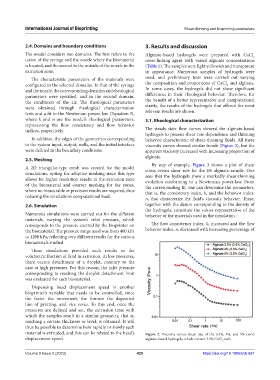
            indices, respectively.                             The steady-state flow curves showed the alginate-based
                                                               hydrogels to present shear rate dependence and thinning
              In addition, the edges of the geometries corresponding   behavior characteristic of shear-thinning fluids. All three
            to the system input, output, walls, and the initial interface   viscosity curves showed similar trends (Figure 2), but the
            were defined in the boundary conditions.           apparent viscosity increased with increasing proportion of
                                                               alginate.
            2.5. Meshing
                                                                 By way of example,  Figure  3 shows a plot of shear
            A 2D triangular-type mesh was created for the model   stress versus shear rate for the 4% alginate sample. One
            simulations, opting for adaptive meshing since this type   sees that the hydrogels show a markedly shear-thinning
            allows for higher resolution results in the extrusion zone   evolution conforming to a Newtonian power-law. From
            of the biomaterial and coarser meshing for the zones,   the corresponding fit, one can determine the parameters,
            where no measurable or precision results are required, thus   that is, the consistency index, k, and the behavior index,
            reducing the simulation’s computational load.
                                                               n, that characterize the fluid’s viscosity behavior. These,
            2.6. Simulation                                    together with the datum corresponding to the density of
                                                               the hydrogels, constitute the values representative of the
            Numerous simulations were carried out for the different   behavior of the materials used in the simulation.
            materials, varying the system’s inlet pressure, which
            corresponds to the pressure exerted by the bioprinter on   The flow consistency index, k, increased and the flow
            the biomaterial. The pressure range used was from 400 kPa   behavior index, n, decreased with increasing percentage of
            to 1200 kPa, reflecting very different results for the various
            biomaterials studied.
              These simulations provided such results as the
            volumetric fraction of fluid in extrusion. At low pressures,
            there occurs detachment of a droplet, contrary to the
            case at high pressures. For this reason, the inlet pressure
            corresponding to reaching the droplet detachment limit
            was evaluated for each biomaterial.

              Dispensing head displacement speed is another
            bioprinter’s variable that needs to be controlled, since
            the  faster  the  movement,  the  thinner  the  deposited
            line  of printing,  and  vice versa. To  this end, once  the
            pressures are defined and set, the extrusion time with
            which the samples result in a similar geometry, that is,
            reaching a certain thickness or level, is obtained. It will
            thus be possible to determine how rapidly or slowly each
            material is extruded, and this can be related to the head’s   Figure  2.  Viscosity versus shear rate of the 3.5%, 4%, and 5% (w/v)
            displacement speed.                                alginate-based hydrogels, which contain 3.5% CaCl each.
                                                                                                2

            Volume 9 Issue 2 (2023)                        425                         https://doi.org/10.18063/ijb.687

