


Page 432 - IJB-9-2
P. 432
International Journal of Bioprinting                               Shear-thinning and bioprinting parameters


            manage to imitate the desired scenario. In the present   2.2. Rheological characterization
            study,  we used the COMSOL multiphysics  software   The rheological properties of the hydrogels were determined
            package. This allows the model to be defined in terms   with a rotational rheometer (Discovery DHR-2, TA
            of its geometry and constraints and the fluid’s physical   Instruments), using a 40 mm parallel plate with a gap of
            conditions. It applies adaptive meshing to allow the   550 μm. Before testing, the samples were left to stand for
            problem to be solved through use of finite element   5 min to allow them to reach mechanical and temperature
            method calculations.                               equilibrium.

              In short, the purpose of this study was to form and   Shear viscosity experiments were carried out with shear
            characterize different alginate-based hydrogels, determine   rates between 0.01 and 1000 s , at a temperature of 37°C,
                                                                                       -1
            and  catalogue  their  rheological  behavior  parameters,   to obtain the mathematical relationship between shear
            and finally simulate bioprinting processes under certain   stress and shear rate and hence the dynamic viscosity of
            conditions.  The  intention  was  to  analyze  the  possible   the hydrogels.
            existence of relationships between the rheological
            parameters or behavior of the hydrogel and the parameters   2.3. Modeling
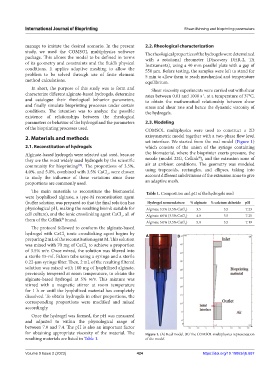
            of the bioprinting processes used.                 COMSOL multiphysics were used to construct a 2D

            2. Materials and methods                           axisymmetric model together with a two-phase flow level
                                                               set interface. We started from the real model (Figure 1)
            2.1. Reconstitution of hydrogels                   which consists of the union of the syringe containing
            Alginate-based hydrogels were selected and used, because   the biomaterial, where the bioprinter exerts pressure, the
                                                                                     ®
            they are the most widely used hydrogels by the scientific   nozzle (model 22G, Cellink ), and the extrusion zone of
            community for bioprinting . The proportions of 3.5%,   air at ambient conditions. The geometry was modeled
                                  [12]
            4.0%, and 5.0%, combined with 3.5% CaCl , were chosen   using trapezoids, rectangles, and ellipses, taking into
                                               2
            to study the influence of these variations since these   account different subdivisions of the extrusion zone to give
            proportions are commonly used.                     an adaptive mesh.
              The main materials to reconstitute the biomaterial   Table 1. Composition and pH of the hydrogels used
            were lyophilized alginate, a type-M reconstitution agent
            (buffer solution was prepared so that the final solution has   Hydrogel nomenclature  % alginate  % calcium chloride  pH
            physiological pH, making the resulting bioink suitable for   Alginate 3.5% (3.5% CaCl )  3.5  3.5  7.23
                                                                                2
            cell culture), and the ionic crosslinking agent CaCl , all of   Alginate 4.0% (3.5% CaCl )  4.0  3.5  7.21
                                                     2
            them of the Cellink  brand.                                         2
                           ®
                                                               Alginate 5.0% (3.5% CaCl )  5.0  3.5       7.19
                                                                                2
              The protocol followed to conform the alginate-based
            hydrogel with CaCl  ionic crosslinking agent begins by   A       B
                            2
            preparing 2 mL of the reconstitution agent M. This solution
            was mixed with 70 mg of CaCl  to achieve a proportion
                                      2
            of 3.5% w/v. Once mixed, the solution was filtered into
            a sterile 15-mL Falcon tube using a syringe and a sterile
            0.22-μm syringe filter. Then, 2 mL of the resulting filtered
            solution was mixed with 100 mg of lyophilized alginate,
            previously tempered at room temperature, to obtain the
            alginate-based hydrogel at 5%  w/v. This mixture was
            stirred  with  a  magnetic  stirrer  at  room  temperature
            for 1 h or until the lyophilized material has completely
            dissolved. To obtain hydrogels in other proportions, the
            corresponding proportions were modified and mixed
            accordingly.
              Once the hydrogel was formed, the pH was measured
            and  adjusted  to  within  the  physiological  range  of
            between 7.0 and 7.4. The pH is also an important factor
            for obtaining appropriate viscosity of the material. The   Figure 1. (A) Real model. (B) The COMSOL multiphysics representation
            resulting materials are listed in Table 1.         of the model.


            Volume 9 Issue 2 (2023)                        424                         https://doi.org/10.18063/ijb.687

