


Page 434 - IJB-9-2
P. 434
International Journal of Bioprinting                               Shear-thinning and bioprinting parameters


            alginate (Table 2). Thus, the lower the alginate percentage,   First,  an adaptive  mesh was  set up  to achieve  a
            the closer the behavior index approaching unity – behavior   balance between good model resolution and acceptable
            typical of a Newtonian fluid. This is attributable to the   computational load to differentiate the volumetric fraction
            properties and influence of the proportion of water present   of the hydrogel from that of the air. The simulation time
            in the samples. The density of the hydrogels also increased   was in the range of 6 – 10 h.
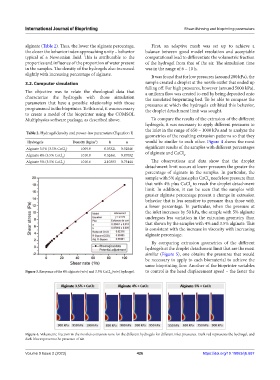
            slightly with increasing percentage of alginate.     It was found that for low pressures (around 200 kPa), the
            3.2. Computer simulation                           sample created a droplet at the nozzle outlet that ended up
                                                               falling off. For high pressures, however (around 5000 kPa),
            The objective was to relate the rheological data that   a uniform flow was created to end by being deposited onto
            characterize the hydrogels with those simulation   the simulated bioprinting bed. To be able to compare the
            parameters that have a possible relationship with those   pressures at which the hydrogels exhibited this behavior,
            programmed in the bioprinter. To this end, it was necessary   the droplet detachment limit was sought.
            to  create  a  model  of  the  bioprinter  using  the  COMSOL
            Multiphysics software package, as described above.   To compare the results of the extrusion of the different
                                                               hydrogels, it was necessary to apply different pressures to
                                                               the inlet in the range of 650 – 1000 kPa and to analyze the
            Table 2. Hydrogel density and power-law parameters (Equation I)
                                                               geometries of the resulting extrusion patterns so that they
             Hydrogels          Density (kg/m )  k     n       would be similar to each other. Figure 4 shows the most
                                          3
            Alginate 3.5% (3.5% CaCl )  1009.9  0.05321  0.92846  significant results of the samples with different percentages
                             2
            Alginate 4% (3.5% CaCl )  1010.8  0.32461  0.87092  of alginate and CaCl .
                                                                               2
                            2
            Alginate 5% (3.5% CaCl )  1016.6  2.10303  0.75444   The observations and data show that the  droplet
                            2
                                                               detachment limit occurs at lower pressures the greater the
                                                               percentage of  alginate in  the  samples.  In particular,  the
                                                               sample with 5% alginate plus CaCl  needs less pressure than
                                                                                          2
                                                               that with 4% plus CaCl  to reach the droplet detachment
                                                                                  2
                                                               limit. In addition, it can be seen that the samples with
                                                               greater alginate percentage present a change in extrusion
                                                               behavior that is less sensitive to pressure than those with
                                                               a lower percentage. In particular, when the pressure at
                                                               the inlet increases by 50 kPa, the sample with 5% alginate
                                                               undergoes less variation in the extrusion geometry than
                                                               that shown by the samples with 4% and 3.5% alginate. This
                                                               is consistent with the increase in viscosity with increasing
                                                               alginate percentage.
                                                                 By comparing extrusion geometries of the different
                                                               hydrogels at the droplet detachment limit that are the most
                                                               similar (Figure  5), one obtains the pressures that would
                                                               be necessary to apply to each biomaterial to achieve the
                                                               same bioprinting flow. Another of the bioprinter variables
            Figure 3. Response of the 4% alginate (w/v) and 3.5% CaCl  (w/v) hydrogel.  to control is the head displacement speed – the faster the
                                                2


            Figure 4. Volumetric fraction in the nozzle’s extrusion zone for the different hydrogels for different inlet pressures. Dark red represents the hydrogel, and
            dark blue represents the presence of air.


            Volume 9 Issue 2 (2023)                        426                         https://doi.org/10.18063/ijb.687

