


Page 441 - IJB-9-2
P. 441
International Journal of Bioprinting                           Bioprinting of DNA hydrogels for bone organoids


            accuracy (reach to 1 µm) or fast printing speed (ranging
            from 25 to 1000 mm/min) of this technology. Higher speed
            can be obtained at the expense of accuracy. The process
            chiefly relies on the light power intensity and the inherent
            properties of printing material . Due to their satisfying
                                     [4]
            biocompatibility, good adaptability, and controllable
            biodegradability, soft biomaterials such as hydrogels have
            opened up a broad insight into tissue regeneration, drug
            delivery, and bio-actuators . With the rapid development
                                 [5]
            of DLP-based 3D printing technology, hydrogels have been
            fabricated into sophisticated architectures (e.g., biomimetic
            scaffolds)  for  bone  regeneration.  However,  traditional
            hydrogels generally undergo rapid biodegradation and have
            weak mechanical properties. Thus, the design principles
            of traditional hydrogels based on DLP technology do
            not take into consideration the biomimetic regulation
            of multiple stages throughout the bone healing, and the
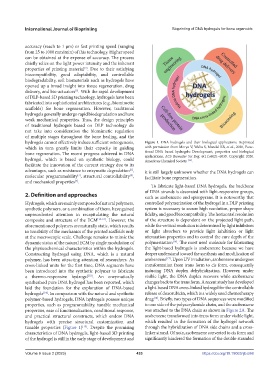
            hydrogels cannot effectively induce sufficient osteogenesis,   Figure  1. DNA hydrogels and their biological applications. Reprinted
            which in turn greatly limits their capacity in guiding   with permission from Morya V, Walia S, Mandal BB, et al., 2020, Func-
            bone regeneration. The recent progress achieved in DNA   tional DNA based hydrogels: Development, properties and biological
                                                               applications.  ACS Biomater Sci Eng, 6(11):6021–6035. Copyright 2020.
            hydrogel, which is based on synthetic biology, could   American Chemical Society.  .
                                                                                 [15]
            facilitate the innovation of the current strategy due to its
            advantages, such as resistance to enzymatic degradation ,   it is still largely unknown whether the DNA hydrogels can
                                                        [6]
            molecular programmability , structural controllability ,   facilitate bone regeneration.
                                                        [8]
                                  [7]
            and mechanical properties .
                                 [9]
                                                                  To fabricate light-based DNA hydrogels, the backbone
                                                               of DNA strands is decorated with light-responsive groups,
            2. Definition and approaches                       such as azobenzene and spiropyrans. It is noteworthy that
            Hydrogels, which are mainly composed of natural polymers,   controlled polymerization of the hydrogel in a DLP printing
            synthetic polymers, or a combination of them, have gained   system is necessary to secure high resolution, proper shape
            unprecedented attention in recapitulating the natural   fidelity, and good biocompatibility. The horizontal resolution
            composite and structure of  the ECM [10-12] . However,  the   of the structure is dependent on the projected light path,
            aforementioned polymers are naturally static, which results   while the vertical resolution is determined by light inhibitors
            in tunability of the mechanics of the printed scaffolds only   or light absorbers to provide light inhibition or light
            at the macroscopic scale. Challenge remains to mimic the   attenuation properties and to control the cure depth of the
                                                                           [16]
            dynamic status of the natural ECM by single modulation of   polymerization . The most used molecule for fabricating
            the physicochemical characteristics within the hydrogels.   the light-based hydrogels is azobenzene because we have
            Constructing hydrogel using DNA, which is a natural   deeper understand toward the synthesis and modification of
            polymer, has been attracting attention of researchers. As   azobenzene . Upon UV irradiation, azobenzene undergoes
                                                                        [17]
            cross-linked units for the first time, DNA segments have   transformation from trans form to cis form, consequently
            been introduced into the synthetic polymer to fabricate   inducing DNA duplex dehybridization. However, under
            a thermo-responsive hydrogel . An enzymatically    visible light, the DNA duplex recovers while azobenzene
                                       [13]
            synthesized pure DNA hydrogel has been reported, which   changes back to the trans form. A recent study has developed
            laid the foundation for the exploration of DNA-based   a light-based DNA cross-linked hydrogel for the controllable
            hydrogels . In comparison with the natural and synthetic   release of doxorubicin, which is a widely used chemotherapy
                   [14]
            polymer-based hydrogels, DNA hydrogels possess unique   drug . Briefly, two types of DNA sequences were modified
                                                                   [18]
            properties, such as programmability, tunable mechanical   to one side of the polyacrylamide chain, and the azobenzene
            properties, ease of functionalization, conditional response,   was attached to the DNA chain as shown in Figure 2A. The
            and practical structural constructs, which endow DNA   azobenzene transformed into trans form under visible light,
            hydrogels with precise structural customization and   which resulted in the formation of the hydrogel network
            tunable properties (Figure 1) . Despite the promising   through the hybridization of DNA side chains and a cross-
                                    [15]
            characteristics of DNA hydrogels, light-based 3D printing   linker strand. Of note, azobenzene converted to cis form and
            of the hydrogel is still in the early stage of development and   significantly hindered the formation of the double-stranded


            Volume 9 Issue 2 (2023)                        433                          https://doi.org/10.18063/ijb.688

