


Page 442 - IJB-9-2
P. 442
International Journal of Bioprinting                           Bioprinting of DNA hydrogels for bone organoids


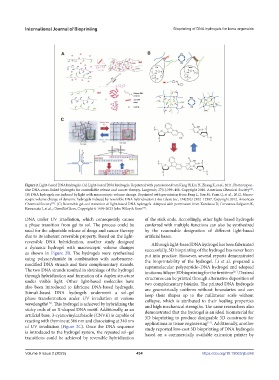
            Figure 2. Light-based DNA hydrogels. (A) Light-based DNA hydrogels. Reprinted with permission from Kang H, Liu H, Zhang X, et al., 2011, Photorespon-
            sive DNA-cross-linked hydrogels for controllable release and cancer therapy. Langmuir, 27(1):399–408. Copyright 2010. American Chemical Society .
                                                                                                           [18]
            (B) DNA hydrogels are induced by light with macro scopic volume change. Reprinted with permission from Peng L, You M, Yuan Q, et al., 2012, Macro-
            scopic volume change of dynamic hydrogels induced by reversible DNA hybridization J Am Chem Soc, 134(29):12302–12307. Copyright 2012. American
            Chemical Society . (C) Reversible gel–sol transition of light-based DNA hydrogels. Adapted with permission from Kandatsu D, Cervantes-Salguero K,
                       [20]
            Kawamata I, et al., ChemBioChem, Copyright © 1999-2023 John Wiley & Sons .
                                                              [19]
            DNA under UV irradiation, which consequently causes   of the stick ends. Accordingly, other light-based hydrogels
            a phase transition from gel to sol. The process could be   conferred with multiple functions can also be synthesized
            used for the adjustable release of drugs and cancer therapy   by the reasonable designation of different light-based
            due to its inherent reversible property. Based on the light-  artificial bases.
            reversible DNA hybridization, another study designed   Although light-based DNA hydrogel has been fabricated
            a dynamic hydrogel with macroscopic volume changes   successfully, 3D bioprinting of the hydrogel has never been
            as shown in  Figure 2B. The hydrogels were synthesized   put into practice. However, several reports demonstrated
            using polyacrylamide in combination with azobenzene-  the bioprintability  of the hydrogel. Li et  al. prepared  a
            modified DNA strands and their complementary strands.   supramolecular polypeptide–DNA hydrogel and adopted
            The two DNA strands resulted in shrinkage of the hydrogel   in situ multilayer 3D bioprinting for the first time . Desired
                                                                                                    [21]
            through hybridization and formation of a duplex structure   structures can be printed through alternative deposition of
            under visible light. Other light-based molecules have   two complementary bioinks. The printed DNA hydrogels
            also been introduced to fabricate DNA-based hydrogels.   are geometrically uniform without boundaries and can
            Stimuli-based DNA hydrogels underwent a sol–gel    keep their shapes up to the millimeter scale without
            phase transformation under UV irradiation at various   collapse, which is attributed to their healing properties
            wavelengths . This hydrogel is achieved by hybridizing the   and high mechanical strengths. The same researchers also
                     [19]
            sticky ends of an X-shaped DNA motif. Additionally, as an   demonstrated that the hydrogel is an ideal biomaterial for
            artificial base, 3-cyanovinylcarbazole (CNVK) is capable of   3D bioprinting to produce designable 3D constructs for
            reacting with thymine at 366 nm and dissociating at 340 nm   applications in tissue engineering . Additionally, another
                                                                                         [21]
            of UV irradiation (Figure 2C). Once the DNA sequence   study reported low-cost 3D bioprinting of DNA hydrogels
            is introduced to the hydrogel system, the repeated sol–gel   based on a commercially available extrusion printer by
            transitions could be achieved by reversible hybridization


            Volume 9 Issue 2 (2023)                        434                          https://doi.org/10.18063/ijb.688

