


Page 93 - IJB-9-3
P. 93
International Journal of Bioprinting                            Biocompatible 3D printing photosensitive resin


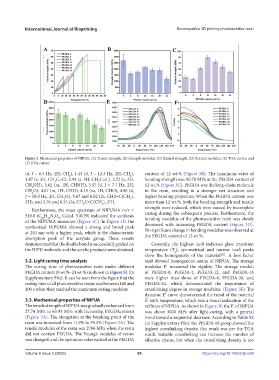
            Figure 3. Mechanical properties of NIPUA. (A) Tensile strength, (B) strength modulus, (C) flexural strength, (D) flexural modulus, (E) TGA curves, and
            (F) DTG curves.
            (d, J = 6.5 Hz, 2H, CH ), 1.43 (d, J = 12.3 Hz, 2H, CH ),   content of 12 wt.% (Figure 3B). The maximum value of
                               2
                                                         2
            1.87 (s, 3H, CH C=C), 1.94 (s, 3H, CH C=C), 2.72 (s, 2H,   bending strength was 90.78 MPa at the PEGDA content of
                                           3
                        3
            CH NH), 3.02 (m, 1H, CHNH), 3.57 (d, J = 7.7 Hz, 2H,   12 wt.% (Figure 3C). PEGDA was the long-chain molecule
               2
            CH O), 4.07 (m, 1H, CHO), 4.19 (m, 1H, CHO), 4.96 (d,   in the resin, resulting in a stronger net structure and
               2
            J = 10.0 Hz, 2H, CH O), 5.67 and 6.02 (2s, CH2=C(CH ),   higher bending properties. When the PEGDA content was
                            2
                                                         3
            2H), and 5.76 and 6.25 (2s, CH C=C(CH ), 2H).      more than 12 wt.%, both the bending strength and tensile
                                     2      3
               Furthermore, the mass spectrum of NIPUMA m/z =   strength were reduced, which were caused by incomplete
            510.8 (C H N O , Calcd. 510.29) indicated the synthesis   curing during the subsequent process. Furthermore, the
                                                               bending modulus of the photosensitive resin was slowly
                   26
                     42
                        2
                          8
            of the NIPUMA monomer (Figure 1C). In Figure 1D, the   decreased with increasing PEGDA content  (Figure 3D).
            synthesized NIPUMA showed a strong and broad peak   No significant change in bending modulus was observed at
            at 250 nm with a higher peak, which is the characteristic   the PEGDA content of 12 wt.%.
            absorption  peak  of  the  acrylate  group.  These  results
            demonstrated that the double bond is successfully grafted on   Generally, the highest tanδ indicates glass transition
            the NIPU molecule, and the acrylic products were obtained.  temperature (T ), symmetrical and narrow tanδ peaks
                                                                            g
                                                               show the homogeneity of the material . A loss factor
                                                                                               [22]
            3.2. Light curing time analysis                    tanδ showed homogenous nature of NIPUA. The storage
            The curing time of photosensitive resin under different   modulus E’ measured the rigidity. The storage moduli
            PEGDA content (0 wt.%–24 wt.%) is shown in Figure S1 (in   of PEGDA-0, PEGDA-4, PEGDA-12, and PEGDA-16
            Supplementary File). It can be seen from the figure that the   were higher than those of PEGDA-8, PEGDA-20, and
            curing time of all photosensitive resins was between 160 and   PEGDA-24, which demonstrated the importance of
            200 s when they reached the maximum curing modulus.   crosslinking degree in storage modulus. (Figure 3E) The
                                                               dynamic E’ curve demonstrated the trend of the material
            3.3. Mechanical properties of NIPUA                E’ with temperature, which was a visual indication of the
            The tensile strength of NIPUA was gradually enhanced from   stiffness of NIPUA. As shown in Figure 3F, the E’ of NIPUA
            27.74 MPa to 63.93 MPa with increasing PEGDAcontent   was above 3000 MPa after light-curing, with a general
            (Figure 3A). The elongation at the breaking point of the   trend toward a sequential decrease. According to Table S2
            resin was increased from 11.9% to 59.2% (Figure 3A). The   (in Supplementary File), the PEGDA-16 group showed the
            tensile modulus of the resin was 2706 MPa when the resin   highest crosslinking density, this result was per the TGA
            did not contain PEGDA. The Young’s modulus of resins   result. Suitable crosslinking can increase the number of
            was changed, and the optimum value existed at the PEGDA   effective chains, but when the crosslinking density is too

            Volume 9 Issue 3 (2023)                         85                         https://doi.org/10.18063/ijb.684

