


Page 116 - IJB-9-4
P. 116
International Journal of Bioprinting                   An inkjet-printed bendable antenna for wearable electronics


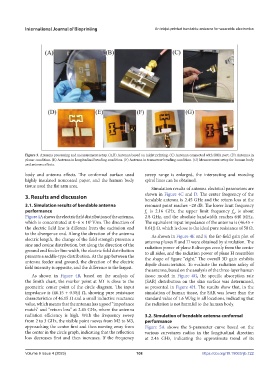
            Figure 3. Antenna processing and measurement setup. (A,B) Antenna based on inkjet printing. (C) Antenna connected with SMA port. (D) Antenna in
            planar condition. (E) Antenna in longitudinal bending condition. (F) Antenna in transverse bending condition. (G) Measurement setup for human body
            and antenna effects.

            body and antenna effects. The conformal  surface used   sweep range is enlarged, the intersecting and receding
            highly insulated noncoated paper, and the human body   spiral lines can be obtained.
            tissue used the flat arm area.
                                                                  Simulation results of antenna electrical parameters are
            3. Results and discussion                          shown in Figure 4C and D. The center frequency of the
                                                               bendable antenna is 2.45 GHz and the return loss at the
            3.1. Simulation results of bendable antenna        resonant point reaches −28 dB. The lower limit frequency
            performance                                        f  is 2.16 GHz, the upper limit frequency  f  is about
                                                                                                     H
                                                               L
            Figure 4A shows the electric field distribution of the antenna,   2.8 GHz, and the absolute bandwidth reaches 640 MHz.
            which is concentrated at 0–6 × 10 V/m. The direction of   The equivalent input impedance of the antenna is (46.45 +
                                       3
            the electric field line is different from the excitation end   0.61j) Ω, which is close to the ideal pure resistance of 50 Ω.
            to the divergence end. Along the direction of the antenna   As shown in Figure 4E and F, the far-field gain plot of
            electric length, the change of the field strength presents a   antenna planes E and H were obtained by simulation. The
            sine and cosine distribution, but along the direction of the   radiation power of plane E diverges evenly from the center
            ground and feeder line width, the electric field distribution   to all sides, and the radiation power of plane H resembles
            presents a saddle-type distribution. At the gap between the   the shape of figure “eight.” The overall 3D gain exhibits
            antenna feeder and ground, the direction of the electric   dipole characteristics. To evaluate the radiation safety of
            field intensity is opposite, and the difference is the largest.  the antenna, based on the analysis of the three-layer human
               As shown in  Figure  4B, based on the  analysis of   tissue model in  Figure 4G, the specific absorption rate
            the Smith chart, the marker point at M1 is close to the   (SAR) distribution on the skin surface  was determined,
            geometric  center  point  of the  circle  diagram.  The  input   as presented in Figure 4H. The results show that, in the
            impedance is (46.15 + 0.58j) Ω, showing pure resistance   simulation of human tissue, the SAR was lower than the
            characteristics of 46.15 Ω and a small inductive reactance   standard value of 1.6 W/kg in all locations, indicating that
            value, which means that the antenna has a good “impedance   the radiation is not harmful to the human body.
            match” and “return loss” at 2.45 GHz, where the antenna
            radiation efficiency is high. With the frequency sweep   3.2. Simulation of bendable antenna conformal
            from 2 to 3 GHz, the visible point moves from M2 to M3,   performance
            approaching the center first and then moving away from   Figure 5A shows the S-parameter curve based on the
            the center in the circle graph, indicating that the reflection   various curvatures radius in the longitudinal direction
            loss decreases first and then increases. If the frequency   at 2.45 GHz, indicating the approximate trend of its


            Volume 9 Issue 4 (2023)                        108                         https://doi.org/10.18063/ijb.722

