


Page 115 - IJB-9-4
P. 115
International Journal of Bioprinting                   An inkjet-printed bendable antenna for wearable electronics


            Table 1. Human tissue model parameters at 2.45 GHz [26]
             Body tissue                         Skin                Fat                  Muscle
             Relative dielectric constant        38.007               5.280               52.729
             Dielectric loss angle               0.283                0.145                0.241
             Magnetic conductivity (s/m)         1.49                 0.11                 1.77
             Thickness (mm)                      2                   10                   28


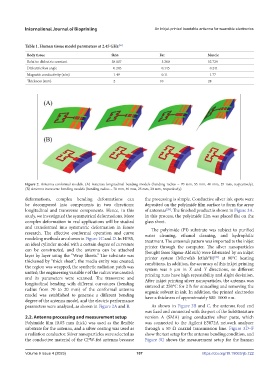
            Figure 2. Antenna conformal models. (A) Antenna longitudinal bending models (bending radius = 70 mm, 55 mm, 40 mm, 25 mm, respectively).
            (B) Antenna transverse bending models (bending radius = 70 mm, 40 mm, 25 mm, 20 mm, respectively).
            deformations, complex bending deformations can     the processing is simple. Conductive silver ink spots were
            be decomposed into components in two directions:   deposited on the polyimide film surface to form the array
            longitudinal and transverse components. Hence, in this   of antennas . The finished product is shown in Figure 3A.
                                                                        [28]
            study, we investigated the symmetrical deformations. More   In this process, the polyimide film was placed flat on the
            complex deformation in real applications will be studied   glass sheet.
            and transformed  into symmetric  deformation in  future   The polyimide (PI) substrate was subject to purified
            research. The effective conformal operation and curve   water cleaning, ethanol cleaning, and hydrophilic
            modeling methods are shown in Figure 1C and D. In HFSS,   treatment. The antenna’s pattern was imported to the inkjet
            an ideal cylinder model with a certain degree of curvature   printer through the computer. The silver nanoparticles
            can  be  constructed, and  the  antenna  can be  attached   (bought from Sigma-Aldrich) were fabricated by an inkjet
            layer by layer using the “Wrap Sheets.” The substrate was   printer system (Microfab Jetlab®II)  at 90°C heating
                                                                                             [29]
            thickened by “thick sheet”; the media entity was created;   conditions. In addition, the accuracy of this inkjet printing
            the region was wrapped, the synthetic radiation patch was   system was 5 μm in  X and  Y directions, so different
            united; the engineering variable r of the radius was created;   printing runs have high repeatability and slight deviation.
            and  its  parameters  were  scanned.  The  transverse  and   After inkjet printing silver nanoparticles, the antenna was
            longitudinal bending with different curvatures (bending   sintered at 250°C for 2 h for annealing and removing the
            radius  from  70  to  20  mm)  of  the  conformal  antenna   organic solvent in ink. In addition, the printed electrodes
            model was established to generate a different bending   have a thickness of approximately 800–1000 nm.
            degree of the antenna model, and the electric performance
            parameters were analyzed, as shown in Figure 2A and B.  As shown in Figure 3B and C, the antenna feed end
                                                               was fixed and connected with the port of the SubMiniature
            2.2. Antenna processing and measurement setup      version A (SMA) using conductive silver paste, which
            Polyimide film (0.05 mm thick) was used as the flexible   was connected to the Agilent E5072A network analyzer
            substrate for the antenna, and a silver coating was used as   through  a  50  Ω coaxial  transmission  line.  Figure  3D–F
            a radiation conductor. Silver nanoparticles were selected as   show the test setup for the antenna bending condition, and
            the conductive material of the CPW-fed antenna because   Figure 3G shows the measurement setup for the human


            Volume 9 Issue 4 (2023)                        107                         https://doi.org/10.18063/ijb.722

