


Page 45 - IJB-9-4
P. 45
International Journal of Bioprinting             3D-Bioprinted human lipoaspirate-derived cell-laden skin constructs


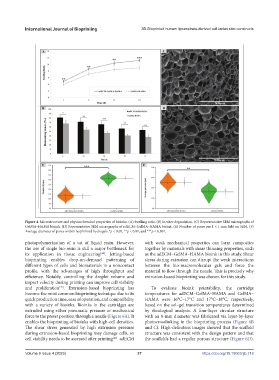
            Figure 4. Microstructure and physicochemical properties of bioinks. (A) Swelling ratio. (B) In vitro degradation. (C) Representative SEM micrographs of
            GelMA–HAMA bioink. (D) Representative SEM micrographs of adECM–GelMA–HAMA bioink. (E) Number of pores per 1 × 1 mm field on SEM. (F)
            Average diameter of pores within lyophilized hydrogels.*p < 0.05, **p < 0.01, and ***p < 0.001.

            photopolymerization of a vat of liquid resin. However,   with weak mechanical properties can form composites
            the use of single bio-resin is still a major bottleneck for   together by materials with shear thinning properties, such
            its application in tissue engineering . Jetting-based   as the adECM–GelMA–HAMA bioink in this study. Shear
                                            [44]
            bioprinting enables drop-on-demand patterning of   stress during extrusion can disrupt the weak interactions
            different types of cells and biomaterials in a noncontact   between the bio-macromolecular gels and force the
            profile, with the advantages of high throughput and   material to flow through the nozzle. This is precisely why
            efficiency. Notably, controlling the droplet volume and   extrusion-based bioprinting was chosen for this study.
            impact velocity during printing can improve cell viability
            and proliferation . Extrusion-based bioprinting has   To evaluate bioink printability, the cartridge
                          [45]
            become the most common bioprinting technique due to its   temperatures for adECM–GelMA–HAMA and GelMA–
            quick production time, ease of operation, and compatibility   HAMA were 16°C–17°C and 17°C–18°C, respectively,
            with a variety of bioinks. Bioinks in the cartridges are   based on the sol–gel transition temperatures determined
            extruded using either pneumatic pressure or mechanical   by rheological analysis. A four-layer circular structure
            force to the preset position through a nozzle (Figure 6A). It   with an 8-mm diameter was fabricated via layer-by-layer
            enables the bioprinting of bioinks with high-cell densities.   photocrosslinking in  the  bioprinting  process (Figure  6B
            The shear stress generated by high extrusion pressure   and C). High-definition images showed that the scaffold
            during extrusion-based bioprinting may damage cells, so   structure was consistent with the design pattern and that
            cell viability needs to be assessed after printing . adECM   the scaffolds had a regular porous structure (Figure 6D).
                                                 [46]

            Volume 9 Issue 4 (2023)                         37                          https://doi.org/10.18063/ijb.718

