


Page 66 - IJB-9-5
P. 66
International Journal of Bioprinting                        3D-printed PLA-BG composite induces angiogenesis


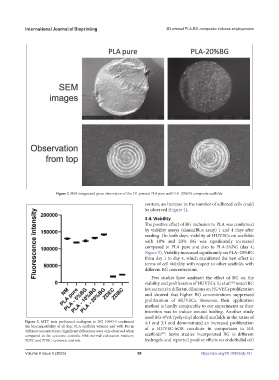
                         Figure 2. SEM images and gross observation of the 3D-printed PLA pure and PLA–20%BG composite scaffolds.
                                                               content, an increase in the number of adhered cells could
                                                               be observed (Figure 4).
                                                               3.4. Viability
                                                               The positive effect of BG inclusion to PLA was confirmed
                                                               by viability assays (alamarBlue assay) 1 and 4 days after
                                                               seeding. On both days, viability of HUVECs on scaffolds
                                                               with 10% and 20% BG was significantly increased
                                                               compared to PLA pure and also to PLA-5%BG (day 4;
                                                               Figure 5). Viability increased significantly on PLA–20%BG
                                                               from day 1 to day 4, which manifested the best effect in
                                                               terms of cell viability with respect to other scaffolds with
                                                               different BG concentrations.
                                                                  Few studies have analyzed the effect of BG on the
                                                                                                   [26]
                                                               viability and proliferation of HUVECs. Li et al.  tested BG
                                                               ion extracts in different dilutions on HUVECs proliferation
                                                               and showed that higher BG concentrations suppressed
                                                               proliferation of HUVECs. However, their application
                                                               method is hardly comparable to our experiments as their
                                                               intention was to induce wound healing. Another study
                                                               used BG–PVA (polyvinyl alcohol) scaffolds in the ratios of
            Figure 3. MTT tests performed analogous to ISO 10993-5 confirmed   4:1 and 3:1 and demonstrated an increased proliferation
            the biocompatibility of all four PLA scaffolds without and with BG in   of a HUVEC-hOB coculture in comparison to HA
            different concentrations. Significant differences were only observed when   [28]
            compared to the cytotoxic controls. NM: normal cultivation medium;   scaffolds . Some studies incorporated BG in different
            ZDEC and ZDBC: cytotoxic controls.                 hydrogels and reported positive effects on endothelial cell

            Volume 9 Issue 5 (2023)                         58                         https://doi.org/10.18063/ijb.751

