


Page 68 - IJB-9-5
P. 68
International Journal of Bioprinting                        3D-printed PLA-BG composite induces angiogenesis


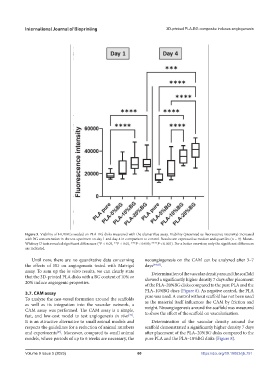
            Figure 5. Viability of HUVECs seeded on PLA–BG disks measured with the alamarBlue assay. Viability (presented as fluorescence intensity) increased
            with BG concentration in the test specimen on day 1 and day 4 in comparison to control. Results are expressed as median and quartiles (n = 9). Mann–
            Whitney U tests revealed significant differences (*P < 0.05, **P < 0.01, ***P < 0.005; ****P < 0.001). For a better overview, only the significant differences
            are indicated.

               Until now, there are no quantitative data concerning   neoangiogenesis on the CAM can be analyzed after 3–7
            the effects of BG on angiogenesis tested with Matrigel   days [44,45] .
            assay. To sum up the in vitro results, we can clearly state   Determination of the vascular density around the scaffold
            that the 3D-printed PLA disks with a BG content of 10% or   showed a significantly higher density 7 days after placement
            20% induce angiogenic properties.                  of the PLA–20%BG disks compared to the pure PLA and the
                                                               PLA–10%BG discs (Figure 8). As negative control, the PLA
            3.7. CAM assay                                     pure was used. A control without scaffold has not been used
            To analyze the neo-vessel formation around the scaffolds   as the material itself influences the CAM by friction and
            as well as its integration into the vascular network, a   weight. Neoangiogenesis around the scaffold was measured
            CAM assay was performed. The CAM assay is a simple,   to show the effect of the scaffold on vascularization.
                                                        [42]
            fast, and low-cost model to test angiogenesis  in vivo .
            It is an attractive alternative to small animal models and   Determination of the vascular density around the
            respects the guidelines for a reduction of animal numbers   scaffold demonstrated a significantly higher density 7 days
                         [43]
            and experiments . Moreover, compared to small animal   after placement of the PLA–20%BG disks compared to the
            models, where periods of up to 6 weeks are necessary, the   pure PLA and the PLA–10%BG disks (Figure 8).

            Volume 9 Issue 5 (2023)                         60                         https://doi.org/10.18063/ijb.751

