


Page 143 - IJB-9-6
P. 143
International Journal of Bioprinting                     3D printed bioactive dressings for burn wound treatment


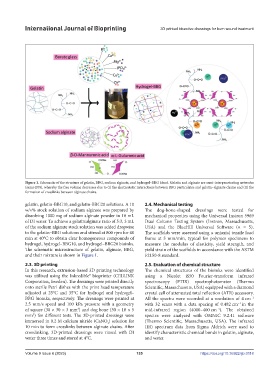
            Figure 1. Schematic of the structure of gelatin, BBG, sodium alginate, and hydrogel–BBG blend. Gelatin and alginate are semi-interpenetrating networks
            (semi-IPN), whereby the free volume decreases due to (i) the electrostatic interactions between BBG particulates and gelatin–alginate chains and (ii) the
            formation of crosslinks between alginate chains.


            gelatin, gelatin-BBG10, and gelatin-BBG20 solutions. A 10   2.4. Mechanical testing
            w/v% stock solution of sodium alginate was prepared by   The dog-bone-shaped dressings were tested for
            dissolving 1000 mg of sodium alginate powder in 10 mL   mechanical properties using the Universal Instron 5969
            of DI water. To achieve a gelatin:alginate ratio of 5:3, 3 mL   Dual Column Testing System (Instron, Massachusetts,
            of the sodium alginate stock solution was added dropwise   USA) and the BlueHill Universal Software (n = 5).
            to the gelatin–BBG solutions and stirred at 800 rpm for 40   The scaffolds were assessed using a uniaxial tensile load
            min at 40°C to obtain clear homogeneous compounds of   frame at 5 mm/min, typical for polymer specimens to
            hydrogel, hydrogel–BBG10, and hydrogel–BBG20 bioinks.   measure the modulus of elasticity, yield strength, and
            The schematic microstructure of gelatin, alginate, BBG,   yield strain of the scaffolds in accordance with the ASTM
            and their mixture is shown in Figure 1.            F2150-8 standard.

            2.3. 3D printing                                   2.5. Evaluation of chemical structure
            In this research, extrusion-based 3D printing technology   The chemical structures of the bioinks were identified
            was  utilized  using  the Inkredible®  bioprinter  (CELLINK   using a Nicolet iS50 Fourier-transform infrared
            Corporation, Sweden). The dressings were printed directly   spectroscopy  (FTIR)  spectrophotometer  (Thermo
            onto sterile Petri dishes with the print head temperature   Scientific, Massachusetts, USA) equipped with a diamond
            adjusted at 25°C and 35°C for hydrogel and hydrogel–  crystal cell of attenuated total reflection (ATR) accessory.
            BBG bioinks, respectively. The dressings were printed at   All the spectra were recorded at a resolution of 4 cm
                                                                                                            −1
            2.5 mm/s speed and 100 kPa pressure with a geometry   with  32  scans with  a data  spacing  of  0.482 cm in  the
                                                                                                       −1
                                  3
            of square (30 × 30 × 3 mm ) and dog bone (30 × 10 × 5   mid-infrared region (4000–400 cm ). The obtained
                                                                                             −1
            mm ) for different tests. The 3D-printed dressings were   spectra were analyzed with OMNIC 9.2.41 software
               3
            immersed in 0.2 M calcium nitride (CaNO ) solution for   (Thermo  Scientific,  Massachusetts,  USA).  The  infrared
                                               3
            10 min to form crosslinks between alginate chains. After   (IR) spectrum data from Sigma Aldrich were used to
            crosslinking, 3D-printed dressings were rinsed with DI   identify characteristic chemical bonds in gelatin, alginate,
            water three times and stored at 4°C.               and water.
            Volume 9 Issue 6 (2023)                        135                         https://doi.org/10.36922/ijb.0118

