


Page 144 - IJB-9-6
P. 144
International Journal of Bioprinting                      3D printed bioactive dressings for burn wound treatment


            2.6. Swelling capacity and biodegradation rate     where  W  is the initial weight,  W  is the weight after
                                                                       0
                                                                                            H
            measurement                                        heating at 250°C, and W  is the weight after 24 h placing
                                                                                   24
            The swelling capacity and degradation rate of the   on dry surfaces.
            3D-printed dressings were measured by measuring the   The water release profile was calculated and plotted
            gravimetric changes of the samples after immersing in   against time (up to 10 days). To determine the water release
            PBS. The samples were weighed, immersed in PBS, and   kinetics, the release profile was analyzed using different
            kept at 32°C to reach equilibrium swelling and subsequent   kinetic models, including zero-order, first-order, Higuchi,
            degradation. The weight changes in determined time   Korsmeyer–Peppas, and Hixon–Crowell for each dressing
            intervals were recorded for up to 7 days as the dressings   formulation .
                                                                        [64]
            are intended to stay on burn wounds for up to 7 days (n
            = 5). The dressing’s swelling capacity and degradation rate   2.8. MTT assay
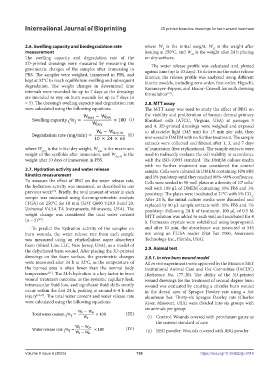
            were calculated using the following equations:     The MTT assay was used to study the effect of BBG on
                                                               the viability and proliferation of human dermal primary
                                                         (I)   fibroblast cells (ATCC, Virginia, USA) at passages 3
                                                               and 4. 3D-printed dressings were weighed and exposed
                                                               to ultraviolet light (345 nm) for 15 min per side, then
                                                        (II)   immersed in DMEM with no further treatment. The sample
                                                               extracts were collected and filtered after 1, 3, and 7 days
            where W  is the initial dry weight, W max  is the maximum   of immersion (five replications). The sample extracts were
                   Dry
            weight of the scaffolds after immersion, and W day10  is the   used to indirectly evaluate the cell viability in accordance
            weight after 10 days of immersion in PBS.          with the ISO-10993 standard. The DMEM culture media
                                                               with no further treatment was considered the control
            2.7. Hydration activity and water release          sample. Cells were cultured in DMEM containing 10% FBS
            kinetics measurement                               and 1% pen/strep until they reached 80%–90% confluence.
            To  measure  the  effect  of  BBG  on the  water  release  rate,   Cells were seeded in 96-well plates at a density of 10  cells/
                                                                                                        4
            the hydration activity was measured, as described in our   well with 100 μL of DMEM containing 10% FBS and 1%
            previous work . Briefly, the total amount of water in each   pen/strep. The plates were incubated at 37°C with 5% CO .
                       [16]
                                                                                                            2
            sample was measured using thermogravimetric analysis   After 24 h, the initial culture media were discarded and
            (TGA) on 250°C for 10 min (SDT Q600 V20.9 Build 20,   replaced by 90 μL sample extracts with 10% FBS and 1%
            Universal V4.5A TA Instruments, Minnesota, USA). The   pen/strep. Following 24 h of treatment, 100 μL of 0.5 M
            weight change was considered the total water content    MTT solution was added to each well and incubated for 4
            (n = 5) .                                          h. Formazan crystals were solubilized using isopropanol,
                 [60]
               To predict the hydration activity of the samples on   and after  30 min, the  absorbance  was measured  at 545
            burn wounds, the water release rate from each sample   nm using an ELISA reader (Stat Fax 2100, Awareness
            was measured using an ethylcellulose super absorbent   Technology Inc., Florida, USA).
            foam (Shield Line LLC, New Jersey, USA), as a model of   2.9. Animal test
            the dehydrated burn wound. After placing the 3D-printed
            dressings on the foam surface, the gravimetric changes   2.9.1. In vivo burn wound model
            were measured after 24 h at 32°C, as the temperature of   All in vivo experiments were approved by the Missouri S&T
            the  burned  area  is  often  lower  than  the  normal  body   Institutional Animal Care and Use Committee (IACUC)
            temperature . The 24-h hydration is a key factor in burn   (Reference No. 177-20). The ability of the 3D-printed
                      [61]
            wound treatment outcome, as the systemic capillary leak,   wound dressings for the treatment of second-degree burn
            intravascular fluid loss, and significant fluid shifts mostly   wound was evaluated by creating a circular burn wound
            occur within the first 24 h, peaking at around 6–8 h after   in the dorsal area of Sprague Dawley rats using a hot
            injury [62,63] . The total water content and water release rate   aluminum bar. Thirty-six Sprague Dawley rats (Charles
            were calculated using the following equations:     River, Missouri, USA) were divided into six groups with
                                                               six animals per group:
                                                       (III)
                                                                 (i)  Control: Wounds covered with petrolatum gauze as
                                                                    the current standard of care
                                                       (IV)     (ii)  BBG powder: Wounds covered with BBG powder


            Volume 9 Issue 6 (2023)                        136                         https://doi.org/10.36922/ijb.0118

