


Page 149 - IJB-9-6
P. 149
International Journal of Bioprinting                     3D printed bioactive dressings for burn wound treatment


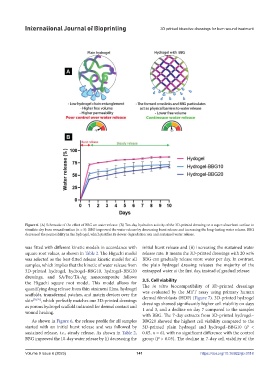
            Figure 6. (A) Schematic of the effect of BBG on water release. (B) Ten-day hydration activity of the 3D-printed dressing on a super-absorbent surface to
            simulate dry burn wound surface (n = 5). BBG improved the water release by decreasing burst release and increasing the long-lasting water release. BBG
            decreased the permeability in the hydrogel, which justifies its slower degradation rate and sustained water release.

            was fitted with different kinetic models in accordance with  initial burst release and (ii) increasing the sustained water
            square root values, as shown in Table 2. The Higuchi model  release rate. It means the 3D-printed dressings with 20 wt%
            was selected as the best-fitted release kinetic model for all  BBG can gradually release more water per day. In contrast,
            samples, which implies that the kinetic of water release from  the plain hydrogel dressing releases the majority of the
            3D-printed hydrogel, hydrogel–BBG10, hydrogel–BBG20  entrapped water at the first day, instead of gradual release.
            dressings, and SA/Pec/TA-Ag nanocomposite follows
            the Higuchi square  root model. This model  allows for   3.5. Cell viability
            quantifying drug release from thin ointment films, hydrogel   The  in vitro biocompatibility of 3D-printed dressings
            scaffolds, transdermal patches, and matrix devices over the   was  evaluated  by  the  MTT  assay  using  primary  human
                                                              dermal fibroblasts (HDF) (Figure 7). 3D-printed hydrogel
            skin [78,79] , which perfectly matches our 3D-printed dressings
            as porous hydrogel scaffold indicated for dermal contact and   dressings showed significantly higher cell viability on days
                                                              1 and 3, and a decline on day 7 compared to the samples
            wound healing.
                                                              with BBG. The 7-day extracts from 3D-printed hydrogel–
               As shown in Figure 6, the release profile for all samples  BBG20 showed the highest cell viability compared to the
            started with an initial burst release and was followed by  3D-printed plain hydrogel and hydrogel–BBG10 (P  <
            sustained release, i.e., steady release. As shown in Table 2,  0.05, n = 6), with no significant difference with the control
            BBG improved the 10-day water release by (i) decreasing the  group (P > 0.05). The decline in 7-day cell viability of the


            Volume 9 Issue 6 (2023)                        141                         https://doi.org/10.36922/ijb.0118

