


Page 152 - IJB-9-6
P. 152
International Journal of Bioprinting                      3D printed bioactive dressings for burn wound treatment


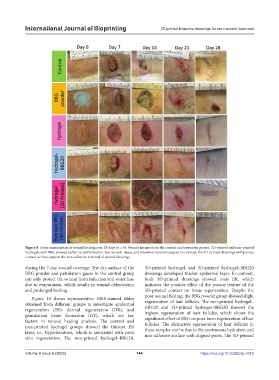
            Figure 8. Gross examination of wound healing over 28 days (n = 6). Wound images from the control and treatment groups. 3D-printed and non-printed
            hydrogels with BBG showed earlier re-epithelization, less necrotic tissue, and smoother wound margins. In contrast, the 3D-printed dressings with porous
            contact surface support the non-adhesive removal of wound dressings.
            during the 7-day wound coverage. The dry surface of the   3D-printed hydrogel, and 3D-printed hydrogel–BBG20
            BBG powder and petrolatum gauze in the control group   dressings developed thicker epidermal layer. In contrast,
            can only protect the wound from infection and water loss   both 3D-printed dressings showed even ER, which
            due to evaporation, which results in wound dehydration   indicates  the  positive  effect  of  the  porous  texture  of  the
            and prolonged healing.                             3D-printed contact on tissue regeneration. Despite the
                                                               poor wound healing, the BBG powder group showed slight
               Figure 10 shows representative H&E-stained slides
            obtained from different groups to investigate epidermal   regeneration of hair follicles. The non-printed hydrogel–
                                                               BBG20 and 3D-printed hydrogel–BBG20 showed the
            regeneration (ER), dermal regeneration (DR), and   highest regeneration of hair follicles, which shows  the
            granulation tissue formation (GT), which are key   significant effect of BBG on post-burn regeneration of hair
            factors in wound healing analysis.  The control and   follicles. The distinctive regeneration of hair follicles in
            non-printed hydrogel groups showed the thickest ER   these samples can be due to the continuous hydration and
            layer,  i.e., hyperkeratosis, which is associated with poor   non-adhesive surface with aligned pores. The 3D-printed
            skin regeneration. The non-printed hydrogel–BBG20,


            Volume 9 Issue 6 (2023)                        144                         https://doi.org/10.36922/ijb.0118

