


Page 153 - IJB-9-6
P. 153
International Journal of Bioprinting                     3D printed bioactive dressings for burn wound treatment


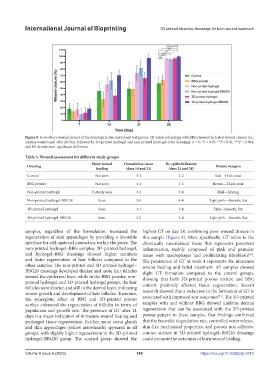
            Figure 9. In vivo burn wound closure of the dressings in the control and test groups. 3D-printed dressings with BBG showed the fastest wound closure (i.e.,
            smaller wound size) after 28 days, followed by 3D-printed hydrogel and non-printed hydrogel–BBG dressings. n = 6; *P < 0.05, **P < 0.01, ***P < 0.001,
            and NS denotes non-significant difference.

            Table 3. Wound assessment for different study groups
                                        Moist wound   Granulation tissue   Re-epithelialization
             Dressing                                                                        Wound margins
                                          healing      (days 14 and 21)  (days 21 and 28)
             Control                      Not seen         3-2               2-2             Red—Thick crust
             BBG powder                   Not seen         4-3               1-3            Brown—Thick crust
             Non-printed hydrogel       Partially seen     3-2               2-4              Pink—Sloping

             Non-printed hydrogel–BBG20    Seen            2-0               4-4          Light pink—Smooth, flat
             3D-printed hydrogel           Seen            3-1               3-4            Pink—Smooth, flat
             3D-printed hydrogel–BBG20     Seen            2-0               4-4          Light pink—Smooth, flat


            samples, regardless of the formulation, increased the  highest GT on day 28, confirming poor wound closure in
            regeneration  of  skin  appendages  by  providing  a  favorable  this sample (Figure 8). More specifically, GT refers to the
            interface for cell–material interaction within the pores. The  chronically  vascularized  tissue  that  represents  persistent
            non-printed hydrogel–BBG samples, 3D-printed hydrogel,   inflammation, mainly composed of pink and granular
            and hydrogel–BBG dressings showed higher numbers   tissue  with  macrophages  and  proliferating  fibroblasts .
                                                                                                           [84]
            and faster regeneration of hair follicles compared to the   The persistence of GT at week 4 represents the immature
            other samples. The non-printed and 3D-printed hydrogel–  wound healing and failed treatment. All samples showed
            BBG20 dressings developed thicker and more hair follicles   slight GT formation compared to the control groups,
            toward the epidermal layer, while in the BBG powder, non-  showing that both 3D-printed porous texture and BBG
            printed hydrogel, and 3D-printed hydrogel groups, the hair   content positively affected tissue regeneration. Recent
            follicles were shorter, and still in the dermal layer, indicating
            slower growth and development of hair follicles. Therefore,   research showed that a reduction in the formation of GT is
                                                                                              [85]
            the synergistic effect of BBG and 3D-printed porous   associated with improved scar outcomes . The 3D-printed
            surface enhanced the regeneration of follicles in terms of   samples with and without BBG showed uniform dermal
            population and growth rate. The presence of GT after 21   regeneration that can be associated with the 3D-printed
            days is a major indication of immature wound healing and   porous pattern in these samples. Our findings confirmed
            prolonged tissue regeneration. Further, more sweat glands   that the favorable degradation rate, controlled water release,
            and skin appendages (yellow arrowheads) appeared in all  skin-like mechanical properties, and porous non-adhesive
            groups, with slightly higher regeneration in the 3D-printed  contact surface in 3D-printed hydrogel–BBG20 dressings
            hydrogel–BBG20 group. The control group showed the  could promote the outcomes of burn wound healing.


            Volume 9 Issue 6 (2023)                        145                         https://doi.org/10.36922/ijb.0118

