


Page 148 - IJB-9-6
P. 148
International Journal of Bioprinting                      3D printed bioactive dressings for burn wound treatment


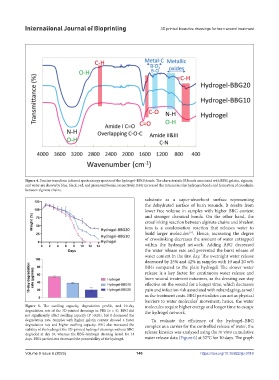
            Figure 4. Fourier-transform infrared spectroscopy spectra of the hydrogel–BBG blends. The characteristic IR bands associated with BBG, gelatin, alginate,
            and water are shown by blue, black, red, and green text/boxes, respectively. BBG increased the intramolecular hydrogen bonds and formation of crosslinks
            between alginate chains.
                                                               substrate as a super-absorbent surface representing
                                                               the  dehydrated  surface  of  burn  wounds.  It  results  from
                                                               lower free volume in samples with higher BBG content
                                                               and stronger chemical bonds. On the other hand, the
                                                               crosslinking reaction between alginate chains and bivalent
                                                               ions is a condensation reaction that releases water to
                                                               build larger molecules . Hence, increasing the degree
                                                                                  [77]
                                                               of crosslinking decreases the amount of water entrapped
                                                               within the hydrogel network. Adding BBG decreased
                                                               the water release rate and prevented the burst release of
                                                               water content in the first day. The overnight water release
                                                               decreased by 25% and 42% in samples with 10 and 20 w%
                                                               BBG compared to the plain hydrogel. The slower water
                                                               release is a key factor for continuous water release and
                                                               burn wound treatment outcomes, as the dressing can stay
                                                               effective on the wound for a longer time, which decreases
                                                               pain and infection risk associated with rebandaging, as well
                                                               as the treatment costs. BBG particulates can act as physical
                                                               barriers to water molecules’ movement; hence, the water
            Figure 5.  The swelling capacity, degradation profile, and 10-day   molecules require higher energy and longer time to escape
            degradation rate of the 3D-printed dressings in PBS (n = 5). BBG did   the hydrogel network.
            not significantly affect swelling capacity (P >0.05), but it decreased the
            degradation  rate.  Samples  with  higher  gelatin  content  showed  a  faster   To  evaluate  the  efficiency of  the  hydrogel–BBG
            degradation rate and higher swelling capacity. BBG also increased the   complex as a carrier for the controlled release of water, the
            stability of the hydrogel: the 3D-printed hydrogel dressings without BBG   release kinetics was analyzed using the in vitro cumulative
            degraded at day 10, whereas the BBG–hydrogel dressing lasted for 14
            days. BBG particulates decreased the permeability of the hydrogel.   water release data (Figure 6) at 32°C for 10 days. The graph


            Volume 9 Issue 6 (2023)                        140                         https://doi.org/10.36922/ijb.0118

