


Page 150 - IJB-9-6
P. 150
International Journal of Bioprinting                      3D printed bioactive dressings for burn wound treatment


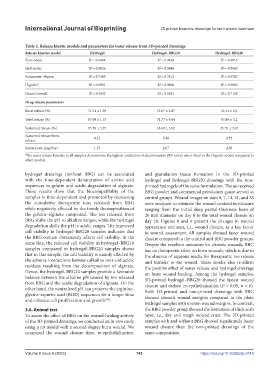
            Table 2. Release kinetic models and parameters for water release from 3D-printed dressings
            Release kinetics model     Hydrogel                   Hydrogel–BBG10             Hydrogel–BBG20
            Zero-order                 R = 0.9494                   R = 0.9183                 R = 0.9815
                                        2
                                                                     2
                                                                                                2
                                        2
                                                                                                2
                                                                     2
            First-order                R = 0.9826                   R = 0.9446                 R = 0.9960
            Korsmeyer–Peppas           R = 0.7389                   R = 0.7112                 R = 0.6782
                                        2
                                                                                                2
                                                                     2
            Higuchi a                  R = 0.9891                   R = 0.9696                 R = 0.9983
                                        2
                                                                     2
                                                                                                2
            Hixon Crowell              R = 0.5432                   R = 0.5831                 R = 0.7138
                                                                                                2
                                        2
                                                                     2
            Drug release parameters
            Burst release (%)          71.51 ± 1.59                 53.07 ± 2.87               42.14 ± 0.2
            Total release (%)          87.09 ± 1.73                 71.77 ± 6.44               67.86 ± 3.2
            Sustained release (%)      15.58 ± 3.27                 18.69 ± 3.82               25.79 ± 3.07
            Sustained release/burst      0.21                         0.38                       0.55
            release
            Release rate (mg/day)        1.73                         2.07                       2.85
            a The water release kinetics in all samples demonstrate the highest coefficient of determination (R2 value) when fitted to the Higuchi model compared to
            other models..
            hydrogel dressings (without BBG) can be associated   and granulation tissue formation in the 3D-printed
            with the time-dependent denaturation of amino acid   hydrogel and hydrogel–BBG20 dressings with the non-
            sequences in gelatin and acidic degradation of alginate.   printed hydrogels of the same formulation. The as-received
            These  results  show  that  the  biocompatibility  of  the   BBG powder and commercial petrolatum gauze served as
            samples is time-dependent and promoted by increasing   control groups. Wound images on days 0, 7, 14, 21, and 28
            the cumulative therapeutic ions released from BBG   were analyzed to estimate the wound contraction/closure
            while negatively affected by the timely decomposition of   ranging from the initial deep partial-thickness burn of
            the gelatin–alginate compound. The ion released from   20 mm diameter on day 0 to the total wound closure on
            BBG shifts the pH to alkaline ranges, while the hydrogel   day 28.  Figures 8 and  9 present the changes in wound
            degradation shifts the pH to acidic ranges. The improved   appearance and area, i.e., wound closure, as a key factor
            cell viability in hydrogel–BBG20 samples indicates that   in wound assessment. All samples showed faster wound
            the BBG content dominantly affects cell viability. In the   closure compared to the control and BBG powder groups.
            same line, the reduced cell viability in hydrogel–BBG10   Despite the excellent outcomes for chronic wounds, BBG
            samples compared to hydrogel–BBG20 samples shows   has no therapeutic effect on burn wounds, which is due to
            that in this sample, the cell viability is mainly affected by   the absence of aqueous media for therapeutic ion release
            the adverse interactions between alkaline ions and acidic   and  transfer  to  the  wound.  These  results  also  re-affirm
            residues resulting from  the decomposition of  alginate.   the positive effect of water release and hydrogel coverage
            Hence, the hydrogel–BBG20 samples provide a favorable   on burn wound healing. Among the hydrogel samples,
            balance between the alkaline pH caused by ion released   3D-printed hydrogel–BBG20 showed the fastest wound
            from BBG and the acidic degradation of alginate. On the   closure and earliest re-epithelialization (P < 0.05, n = 6).
            other hand, the neutralized pH can preserve the arginine-  Both 3D-printed and non-printed dressings with BBG
            glycine-aspartic acid (RGD) sequences for a longer time   showed smooth wound margins compared to the plain
            and enhance cell proliferation and growth .
                                              [80]
                                                               hydrogel samples with uneven wound margins. In contrast,
            3.6. Animal test                                   the BBG powder group showed the formation of thick scab
            To assess the effect of BBG on the wound-healing activity   layer,  i.e., dry and rough wound crust. The 3D-printed
            of the 3D-printed dressings, we conducted an in vivo study   samples with and without BBG showed significantly faster
            using a rat model with a second-degree burn wound. We   wound  closure  than  the  non-printed  dressings  of  the
            compared the wound closure time, re-epithelialization,   same composition.


            Volume 9 Issue 6 (2023)                        142                         https://doi.org/10.36922/ijb.0118

