


Page 147 - IJB-9-6
P. 147
International Journal of Bioprinting                     3D printed bioactive dressings for burn wound treatment


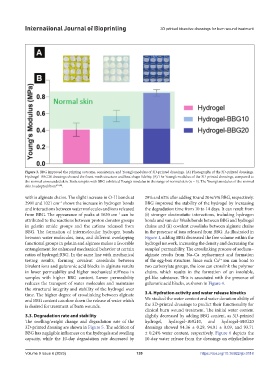
            Figure 3. BBG improved the printing outcome, consistency, and Young’s modulus of 3D-printed dressings. (A) Photographs of the 3D-printed dressings.
            Hydrogel–BBG20 dressings showed the finest mesh structure and best shape fidelity. (B) The Young’s modulus of the 3D-printed dressings, compared to
            the normal unwounded skin. Both samples with BBG exhibited Young’s modulus in the range of normal skin (n = 5). The Young’s modulus of the normal
            skin is adopted from [67,68] .

            within alginate chains. The slight increase in O-H bonds at   29% and 62% after adding 10 and 20 w/v% BBG, respectively.
            2901 and 1021 cm  shows the increase in hydrogen bonds   BBG improved the stability of the hydrogel by increasing
                          −1
            and interactions between water molecules and ions released   the degradation time from 10 to 14 days. It can result from
            from BBG. The appearance of peaks at 1630 cm  can be   (i) stronger electrostatic interactions, including hydrogen
                                                   −1
            attributed to the reactions between proton donator groups   bonds and van der Waals bonds between BBG and hydrogel
            in gelatin amide groups and the cations released from   chains and (ii) covalent crosslinks between alginate chains
            BBG.  The  formation  of intermolecular hydrogen  bonds   in the presence of ions released from BBG. As illustrated in
            between water molecules, ions, and different overlapping   Figure 1, adding BBG decreased the free volume within the
            functional groups in gelatin and alginate makes a favorable   hydrogel network, increasing the density and decreasing the
            entanglement for enhanced mechanical behavior at certain   samples’ permeability. The crosslinking process of sodium–
            ratios of hydrogel:BBG. In the same line with mechanical   alginate results from Na–Ca replacement and formation
            testing results, forming covalent crosslinks between   of the egg-box structure. Since each Ca  ion can bond to
                                                                                              2+
            bivalent ions and guluronic acid blocks in alginate results   two carboxylate groups, the ions can crosslink the polymer
            in lower permeability and higher mechanical stiffness in   chains, which results in the formation of an insoluble,
            samples with higher BBG content. Lower permeability   gel-like substance. This is associated with the presence of
            reduces  the  transport  of  water  molecules  and  maintains   guluronic acid blocks, as shown in Figure 4.
            the structural integrity and stability of the hydrogel over
            time. The higher degree of crosslinking between alginate   3.4. Hydration activity and water release kinetics
            and BBG content can slow down the release of water which   We studied the water content and water donation ability of
            is desired for treatment of burn wounds.           the 3D-printed dressings to predict their functionality for
                                                               clinical burn wound treatment. The initial water content
            3.3. Degradation rate and stability                slightly decreased by adding BBG content, as 3D-printed
            The  swelling/weight  change  and  degradation  rate  of  the   hydrogel,  hydrogel–BBG10,  and  hydrogel–BBG20
            3D-printed dressing are shown in Figure 5. The addition of   dressings showed 94.36 ± 0.29, 94.01 ± 0.09, and 93.71
            BBG has negligible influences on the hydrogels and swelling   ± 0.24% water content, respectively. Figure 6 depicts the
            capacity,  while  the  10-day  degradation  rate  decreased  by   10-day water release from the dressings on ethylcellulose


            Volume 9 Issue 6 (2023)                        139                         https://doi.org/10.36922/ijb.0118

