


Page 515 - IJB-9-6
P. 515
International Journal of Bioprinting                         Advances for 3D-printed oral drug delivery systems


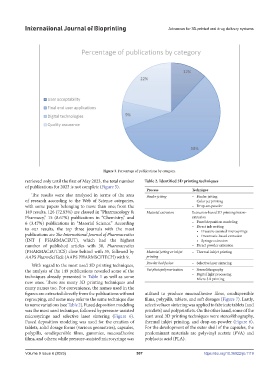
                                             Figure 3. Percentage of publications by category.
            retrieved only until the first of May 2023, the total number   Table 2. Identified 3D printing techniques
            of publications for 2023 is not complete (Figure 5).
                                                                Process            Technique
               The results were  also analyzed  in terms of the  area   Binder jetting    – Binder jetting
            of research according to the Web of Science categories,                   – Color jet printing
            with some papers belonging to more than one; from the                     – Drop-on-powder
            149 results, 126 (72.83%) are classed in “Pharmacology &   Material extrusion  Extrusion-based 3D printing/micro-
            Pharmacy,” 15 (8.67%) publications in “Chemistry,” and                 extrusion
            6  (3.47%)  publications  in  “Material Science.”  According              – Fused deposition modeling
            to our results, the top three journals with the most                      – Direct ink writing
                                                                                     •  Pressure-assisted microsyringe
            publications are The International Journal of Pharmaceutics              •  Pneumatic-based extrusion
            (INT J PHARMACEUT), which had the highest                                •  Syringe extrusion
            number of published articles with 38,  Pharmaceutics                      – Direct powder extrusion
            (PHARMACEUTICS) close behind with 35, followed by   Material jetting or inkjet     – Thermal inkjet printing
            AAPS PharmSciTech (AAPS PHARMSCITECH) with 9.       printing
               With regard to the most used 3D printing techniques,   Powder bed fusion    – Selective laser sintering
            the analysis of the 149 publications revealed some of the   Vat photopolymerization    – Stereolithography
            techniques already presented in Table 1 as well as some                   – Digital light processing
                                                                                      – Micro 3D printing
            new  ones.  There  are  many  3D printing  techniques  and
            many names too. For convenience, the names used in the
            figures are extracted directly from the publications without   utilized to produce mucoadhesive films, orodispersible
            regrouping, and some may refer to the same technique due   films, polypills, tablets, and soft dosages (Figure 7). Lastly,
            to name variations (see Table 2). Fused deposition modeling   selective laser sintering was applied to fabricate tablets (and
            was the most used technique, followed by pressure-assisted   printlets) and polyprintlets. On the other hand, some of the
            microsyringe and selective laser sintering (Figure 6).   least used 3D printing techniques were stereolithography,
            Fused deposition modeling was used for the creation of   thermal inkjet printing, and drop-on-powder (Figure 6).
            tablets, solid dosage forms (various geometries), capsules,   For the development of the outer shell of the capsules, the
            polypills, orodispersible films, gummies, mucoadhesive   predominant materials are polyvinyl acetate (PVA) and
            films, and others; while pressure-assisted microsyringe was   polylactic acid (PLA).


            Volume 9 Issue 6 (2023)                        507                          https://doi.org/10.36922/ijb.1119

