


Page 517 - IJB-9-6
P. 517
International Journal of Bioprinting                         Advances for 3D-printed oral drug delivery systems


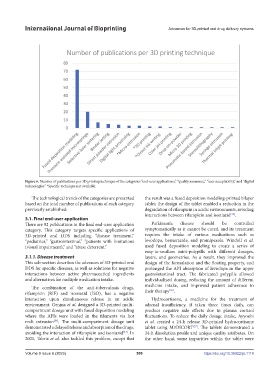
            Figure 6. Number of publications per 3D printing technique of the categories “end-user applications,” “quality assurance,” “user acceptability,” and “digital
            technologies.” *Specific technique not available.

               The technological trends of the categories are presented   the result was a fused deposition modeling-printed bilayer
            based on the total number of publications of each category   tablet; the design of the tablet enabled a reduction in the
            previously established:                            degradation of rifampicin in acidic environments, avoiding
                                                               interactions between rifampicin and isoniazid .
                                                                                                   [35]
            3.1. Final end-user application
            There are 92 publications in the final end-user application   Parkinson’s  disease  should  be  controlled
            category. This category targets specific applications of   symptomatically as it cannot be cured, and its treatment
            3D-printed oral DDS including “disease treatment,”   requires the intake of various medications such as
            “pediatrics,” “gastrointestinal,” “patients with limitations   levodopa,  benserazide,  and  pramipexole.  Windolf  et  al.
            (visual impairment),” and “abuse deterrent.”       used fused deposition modeling to create a series of
                                                               easy-to-swallow mini-polypills with  different dosages,
            3.1.1. Disease treatment                           layers, and geometries. As a result, they improved the
            This sub-section describes the advances of 3D-printed oral   design of the formulation and the floating property, and
            DDS for specific diseases, as well as solutions for negative   prolonged the API absorption of levodopa in the upper
            interactions between active pharmaceutical ingredients   gastrointestinal tract. The fabricated polypills allowed
            and alternatives for multiple medication intake.   individualized dosing, reducing the amount of different

               The combination of the anti-tuberculosis drugs,   medicine intake, and improved patient adherence to
                                                                         [36]
            rifampicin  (RIF)  and  isoniazid  (ISO),  has  a  negative   their therapy .
            interaction upon simultaneous release in an acidic    Hydrocortisone, a medicine for the treatment of
            environment. Genina et al. designed a 3D-printed multi-  adrenal insufficiency, if taken three times daily, can
            compartment dosage unit with fused deposition modeling   produce  negative  side  effects  due  to  plasma  cortisol
            where the APIs were loaded in the filaments via hot   fluctuations. To reduce the daily dosage intake, Ayyoubi
            melt extrusion . The multi-compartment dosage unit   et al. created a 24-h release 3D-printed hydrocortisone
                        [34]
            demonstrated a delayed release and absorption of the drugs,   tablet using M3DICORT . The tablets demonstrated a
                                                                                   [37]
            avoiding the interaction of rifampicin and isoniazid . In   24-h dissolution profile and unique quality attributes. On
                                                      [34]
            2021, Tabriz et al. also tackled this problem, except that   the other hand, some impurities within the tablet were
            Volume 9 Issue 6 (2023)                        509                          https://doi.org/10.36922/ijb.1119

